The baby was bouncing on his grandmother’s knees. He caught my eyes and, as I got closer, he did as little ones are inclined to do and threw his rattle onto the sidewalk. His eyes came back to mine from the beautiful silver rattle. I couldn’t resist the challenge in those eyes dancing with mischief.
I reached for the rattle, shaking it as I handed it back to him. He laughed that contagious giggle of one just beginning to discover the range of life’s delight.
Over his head, his grandmother and I made eye contact and exchanged smiles of joy at the wee one’s innocent pleasure.
I gave him a little wave as I walked on.
It’s been a year but I haven’t forgotten their faces, their eyes.
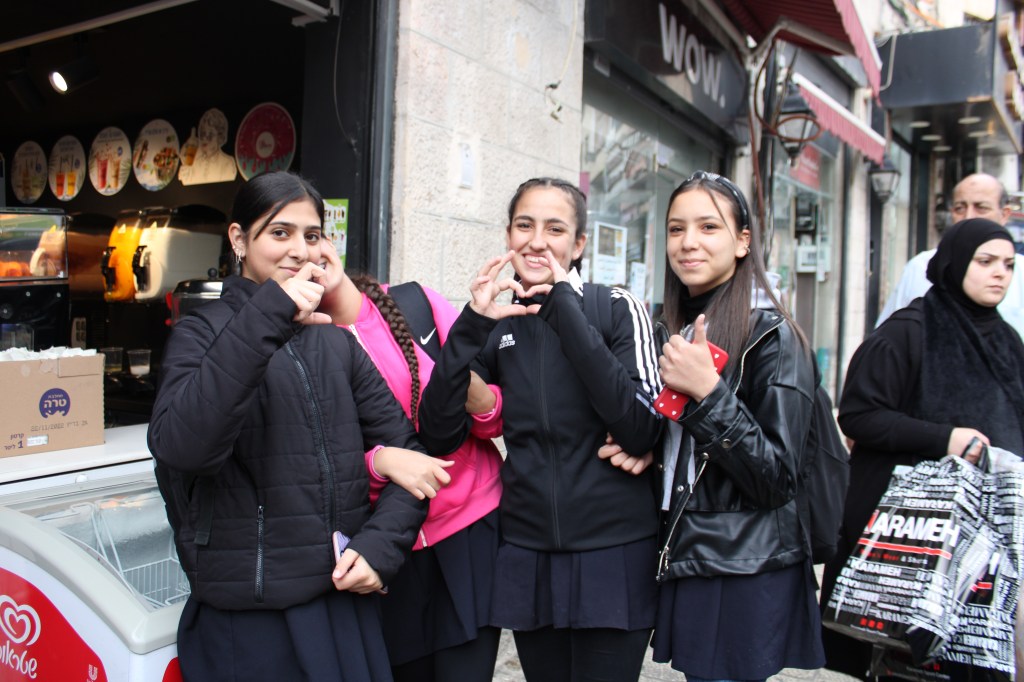
Outside a sweets store, four teenage girls surrounded me practically dancing with enthusiasm and gesturing. At first, thoughts of pickpockets made me pull my purse closer, but, through their giggling, the girls gestured to the camera hanging from my neck.
The idea that in this age of smartphones the girls had never seen a 35mm camera crossed my mind. To break through the language barrier, they gestured holding up the camera and clicking.
I obliged and took a photo of the young friends and classmates.
As they looked at the image on the preview screen, they suddenly got quiet.
I wasn’t sure what to make of their sudden silence, but then they looked up and we all smiled and went on our way.
In the last year, I haven’t forgotten them or their bold curiosity.
It was a battle of wills: feline versus annoyed human.
The cat smelled an easy feast at the open-air restaurant. The server didn’t want the cat interrupting his diners’ meals. The cat would jump onto a window ledge and eye his potential buffets. The server would shew him away.
The scene replayed over and over. An observer had to suspect that this wasn’t the first time the two had tangoed and, before the day was over, I knew the cat would eat well.
Human and feline remain vivid in my memories.
As does the older woodworker whose shop smelled richly of generations of sawdust and imagination and the bus driver who always held out his hand to help me keep my balance stepping down. As kind as he was, he was equally anxious as he and his prepared to welcome their first baby.
Each of their faces and so many others have filled my mind and heart in the last month.
They all lived in Israel-Palestine. I encountered them there just a year ago. Among them were Muslims, Christians, and Jews and Israelis and Palestinians.
In the last month since Hamas terrorists attacked Israel and war began, I’ve hoped they’re all still alive, while knowing beyond a doubt that their worlds have been irrevocably shaken. Life is less secure than it already was. Relatives are likely hurt or dead. Humanity is in crisis as the lives of thousands of children have been lost and far more are at risk.
A rattle’s shake, a baby’s giggle, older eyes locking, beautiful teens eager for a new experience, cat and human engagement, an artisan creating, an expectant dad waiting, they all tell of the life’s glorious ordinariness – the moments that bind so many of us.
I wonder has man’s inhumanity to man now supplanted those moments with the extraordinariness of war?
My mind worries that there’s no hope that even the youngest among the people I encountered will know peace, but then another little boy comes to mind. Consuming the bread of the Lord’s Supper in a Christian church in the West Bank one Sunday last November, he left a trail of crumbs behind as he came back down the church aisle.
Those crumbs, remembering one born in the West Bank thousands of years ago, spoke of a greater abundance of love and hope that exists if only we’ll open ourselves to it.
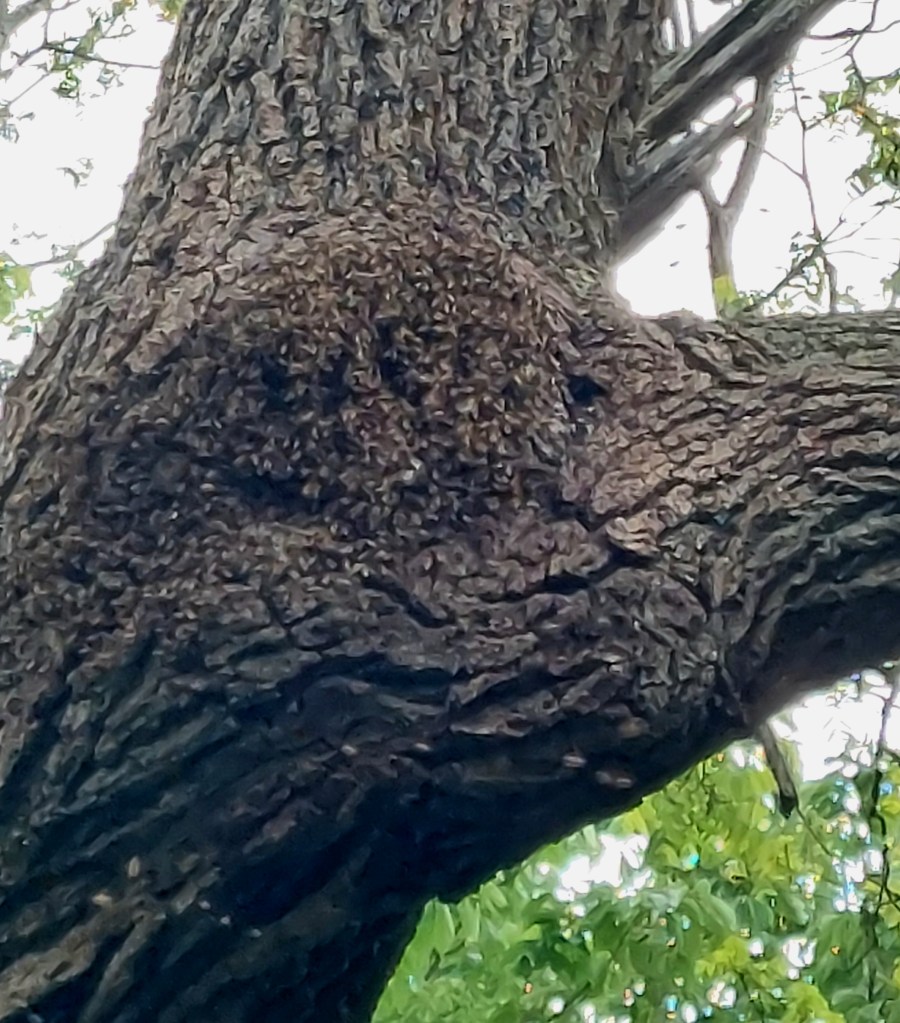
Honeybees swarming in a Max Meadows, Virginia, black walnut tree last Sunday.
The sound of non-stop activity could be heard some distance away and provided the first clue that something special was happening nearby.
Following the sound, our eyes traveled upward into the old black walnut. Life was literally swarming around an opening in the tree. The air vibrated with it.
Honeybees had found a new home! A new colony was being formed.
These marvels of nature can feature hundreds to thousands of honeybees and are amazing to watch.
They made short work of creating a new hive. All were secure in a couple hours. To my eyes it seemed to be an amazingly choreographed dance and a powerful reminder of how interconnected life in our world is — from bees to trees to all the flowers and food they’ll pollinate that we and other critters will eat.
Nature reflects its Creator. Sometimes a grateful Wow is the best prayer followed by a renewed commitment to heeding God’s directive to care for His creation.
The drink the stranger bought me made it all the way to the North Carolina coast.
Too many highway exits with only farmland evident in either direction had passed by. My bladder insisted this one with a couple of options for restrooms was a necessary break in the trip.
Still, I almost backed out as I opened the door to the service station. Anger, yelling between co-workers, smacked me in the face. The argument had something to do with brewing tea before a shift change, but most of the exchange was indecipherable — not for lack of volume but more the speed with which words spewed out.
Still, my bladder persisted and won.
Little had changed when I came out of the restroom, but I decided to get a drink for the next leg of the trip. I grabbed one from the cooler and made my way to the register. A few feet away, I realized an elderly man was heading there, too, from the opposite direction. I slowed and stepped back to let him go ahead.
The tirade paused as one clerk rang up his road snacks. Then, the gentleman told her to add my drink to his charges.
Instinctively, I shook my head no. He persisted, acknowledging that I’d let him go ahead.
Then, the other clerk chimed in, saying, “Accept it, honey, and pass it on.”
I assured him that respect did not need to be rewarded but then smiled and promised to indeed pay his kindness forward. When he looked back at me, I saw such a twinkle in his rheumy eyes that my heart lightened. It was also impossible to miss that the atmosphere in the store was also transformed.
A simple kindness had diffused anger and replaced it with words of blessings and wishes for safe travel.
My fellow traveler reminded me that we should never underestimate the power of even the smallest kindness. His gesture certainly made multiple lives instantly better.
In my mind, I also heard another reminder, ancient yet so applicable to this time when so many seem so afraid of one another: Do not forget to show hospitality to strangers, for by so doing some people have shown hospitality to angels without knowing it.
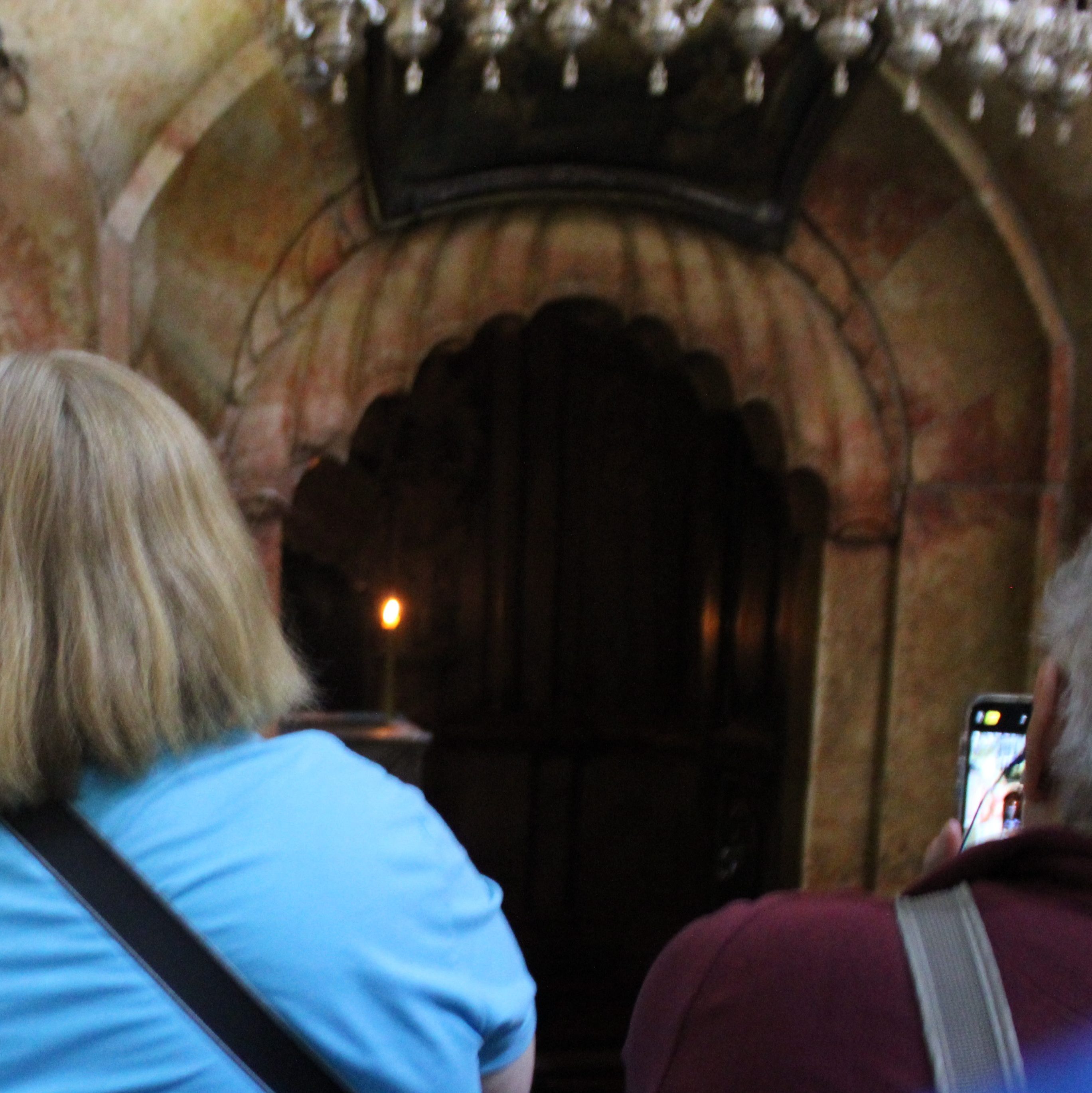
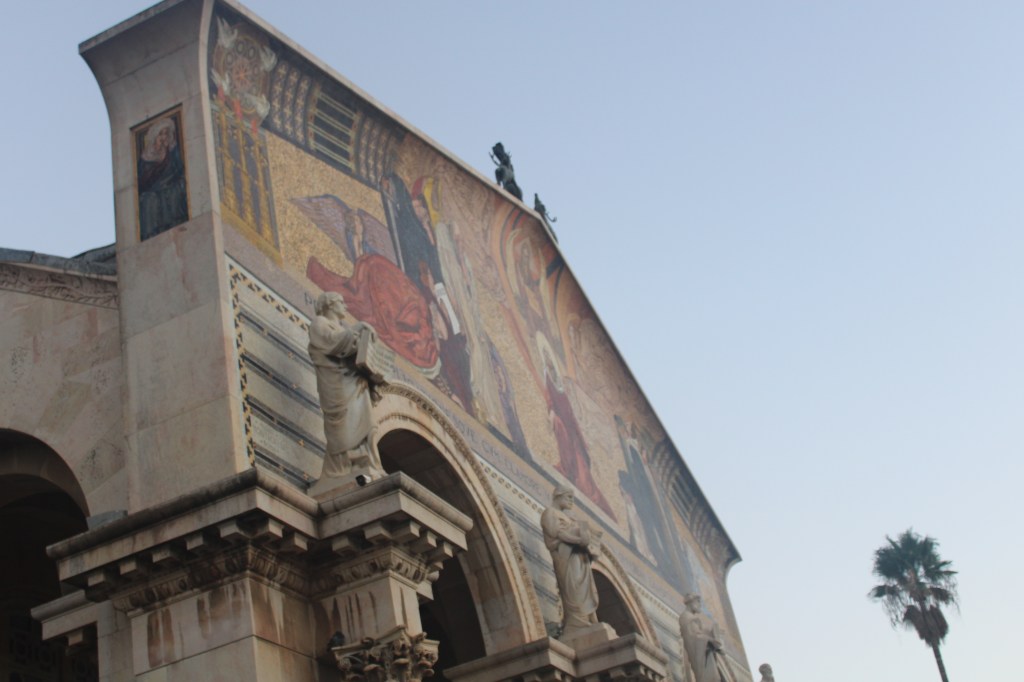
The Church of the Holy Sepulchre in the Old City of Jerusalem houses one of the sites believed to have been the tomb where Jesus was buried and resurrected. Photos aren’t allowed inside the tomb.
The end of the line wasn’t visible – so many people crowded into such a tight space. They were acting as we so often do in such situations. Patience was fraying; grumbling intensified as time passed. A man in our group was grabbed by the arm, others wanting to move him as they tried to push their way forward. Such behavior wouldn’t have been great no matter the circumstances, but we were waiting to see one of the sites contended to be Jesus’ tomb.
Somehow irritation and grousing didn’t seem fitting for hundreds of people, many of whom declared themselves to be followers of Jesus.
Still, I have to admit that my nerves were also threadbare from the sardine-can conditions, but, finally, the moment arrived when I was allowed to bow down and enter the revered space. I wish I could tell you that the experience was miraculous or even awe-inspiring, but before my eyes could adjust to the lower light, the priest directing the human traffic ordered me to leave.
The disappointment ached deep inside my gut and lingered there. Suddenly, weariness washed over me and tears threatened to spill.
These months after returning from Jerusalem, the emotions of those moments abide with me, but now I put them next to words from John’s gospel: “Early on the first day of the week, while it was still dark, Mary Magdalene came to the tomb…”
My heart rests on the words “while it was still dark.”
I can only imagine that tears still flowed with little, if any, prompting, and Mary’s body felt cold and aching as she processed the horrific trauma and grief of watching Jesus – her teacher, her friend, her Lord — executed in such a prolonged and agonizing way. Everything was most decidedly “still dark.”
As I watch the news from Israel-Palestine these days, much continues to seem to be immersed in darkness in that land considered holy by so many. Places we explored with wonder are now scenes of violence.
Of course, we aren’t exempt from that darkness. We may not be experiencing such visible state-led clashes inside places of worship, but hate crimes, often directed toward those of faith, continue to escalate.
More mass shootings have occurred in our midst this year than there have been days.
Divisions among people seem as striking as ever.
In our own lives, loss can seem pervasive. Seemingly daily, news of another horrific diagnosis in a loved one finds our way to us. Job losses loom. Relationships unravel. We fight within ourselves to tamp down the edge in our voices. Somedays, we seek out the solitude of our vehicles or a restroom to hold our heads in our hands and allow the sighs and tears a moment of expression.
Looking back over the last year, so many faces come to mind of cherished friends and family who’ve died, including those of two dear children.
Many of us make our way to tombs of all sorts while it is still dark.
However, we can’t stop there. We must keep reading Mary’s story.
Seeing the tomb rolled away, her darkness deepens. The last straw breaks. She believed Jesus’ body had been stolen. “Mary stood weeping outside the tomb.”
***
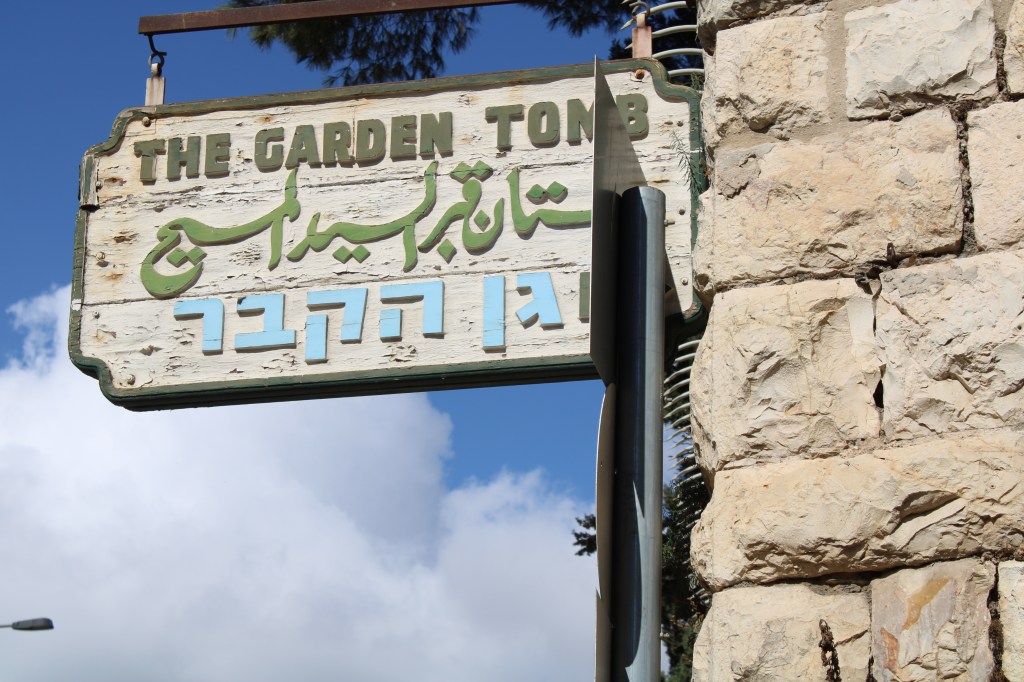
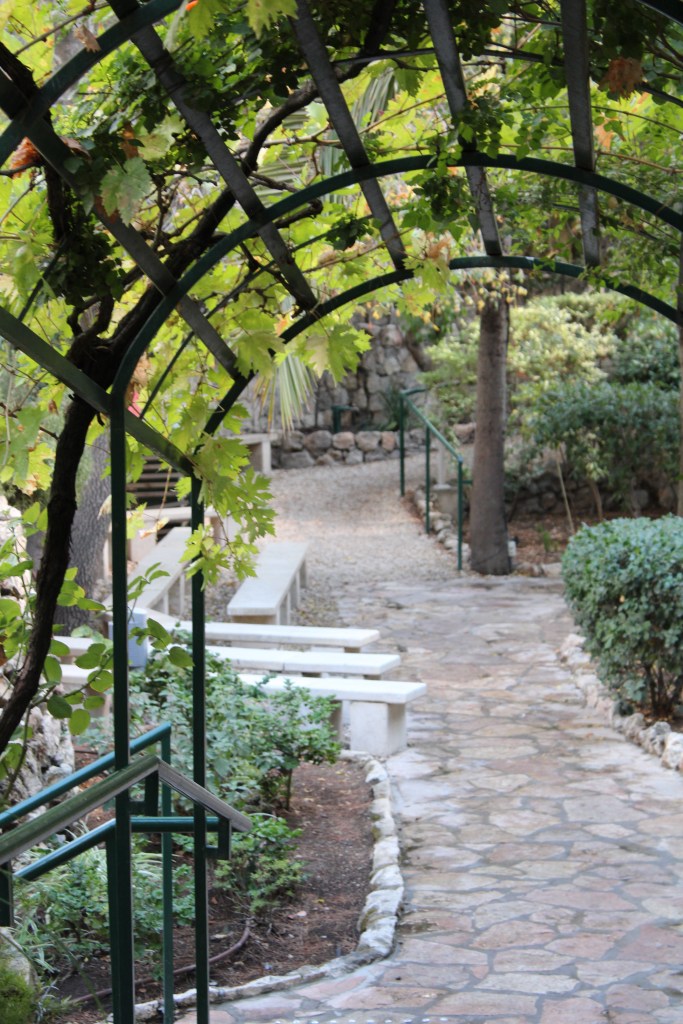
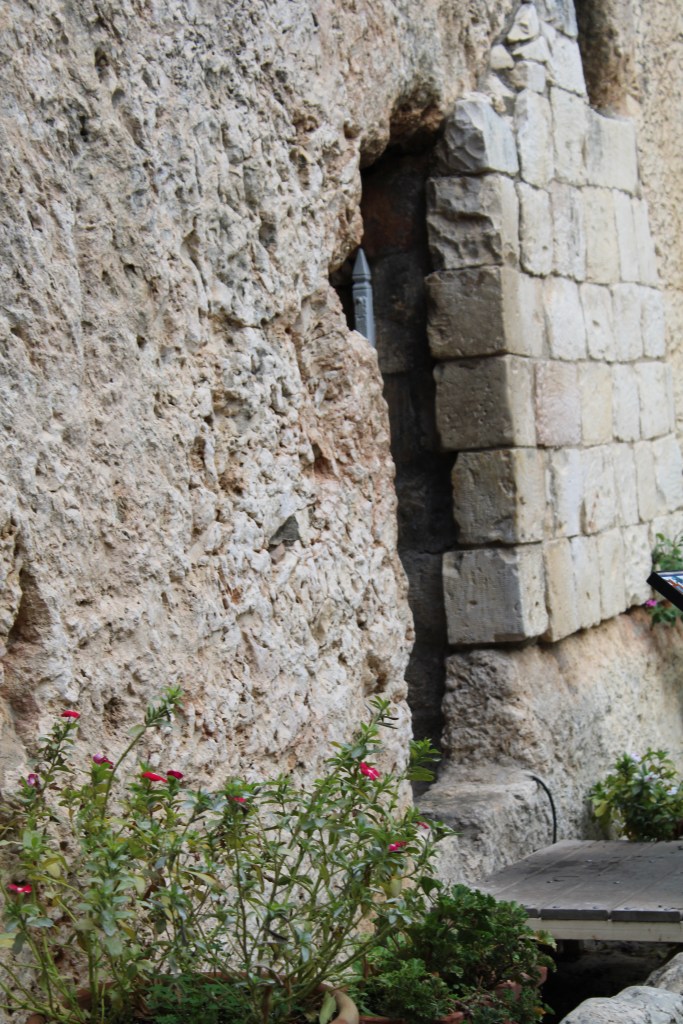
The next day on our pilgrimage we were to visit another site argued to have served as Jesus’ tomb. I was not optimistic, but this one proved to be far less crowded and the area around it had been cared for as a beautiful garden with places for prayer and meditation.
One of the guides shared the reasons why some believe this location to be the true tomb site. I couldn’t really weigh the archeological and geographic arguments – not without much more information, but what I could assess was the wonder and love with which he spoke, the kindness and light in his eyes, the caring that had brought him from another country to this land to help share Jesus’ message.
He left our group with the elements for the Lord’s Supper and, after partaking, we made our way to the tomb site.
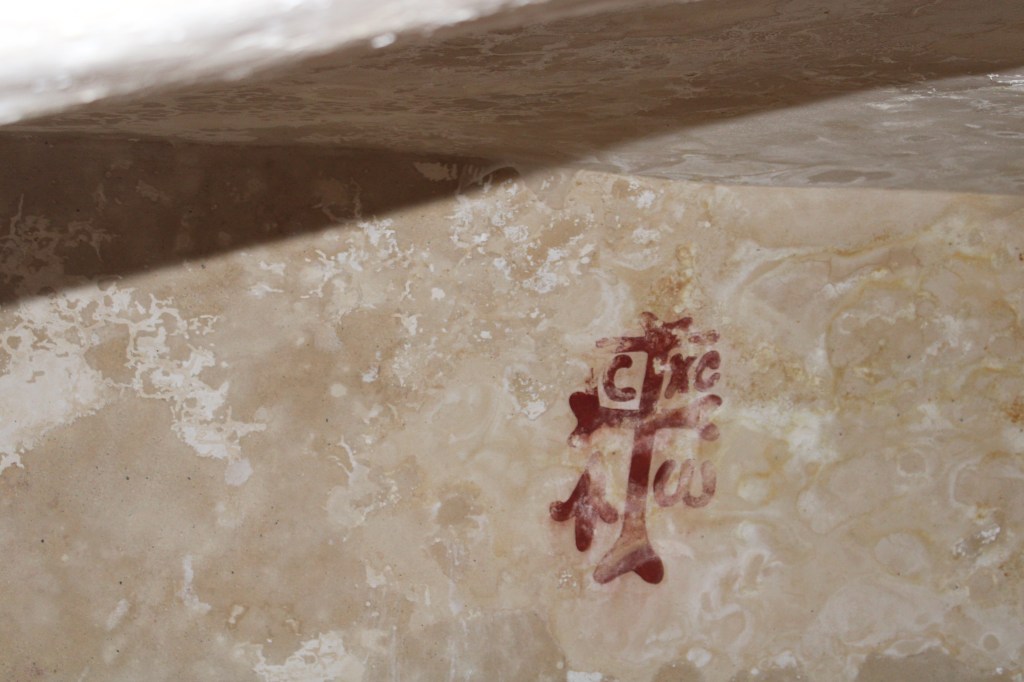
Once inside, there was time to pause, to touch the rock walls, to pray — to, through our spirits, hear as Mary did Jesus call our name.
Jesus said to her, “Mary!” She turned and said to him in Hebrew, “Rabbouni!” (which means Teacher).”
On this and every day, no matter the darkness, we can also pause and hear him call our name. In response, we can be followers who heed the directive the Teacher gave us the night before his death: “that you love one another as I have loved you.”
To do so, we must also remember that Jesus didn’t ask Mary to linger at the empty tomb, but he sent her out to proclaim his message. Jesus told Mary to go and tell.
She did. She declared, “I have seen the Lord.”
May you see the Lord in someone’s eyes today and may you show others Jesus through yours.
My thoughts have revolved around mud for much of today.
Initially, I’ll lay blame for the mud on one of our canine neighbors, Jess. She came for a visit during yesterday’s rain. It’s fair to say that Jess has me wrapped around her paw. She bats those brown eyes at me…, and, well, a wet dog gets full access to the house. Yesterday was no different, but her paws were muddy! She was muddy! Even with sweeping and mopping, I suspect we’ll be finding traces of Jess’ visit for months to come.
As I tackled some of the muddy evidence earlier, another murky path came to mind – Jesus’ route into Jerusalem.
Today in church, children waved palmed branches, walking down the aisles of the carpeted sanctuary.
However, the path Jesus took doesn’t strike me as quite so neat.
As he makes his entrance, the Gospel of Matthew tells us: “A very large crowd spread their cloaks on the road, while others cut branches from the trees and spread them on the road.”
Jesus was being treated as a king. People were demonstrating their utmost respect for him. He wasn’t going to get splattered by mud or worse.
Even more, by laying down their cloaks, individuals were leaving themselves exposed without this traditionally protective and highly valued garment. In the Old Testament, the prophet Elijah leaves his cloak to his successor, Elisha. The cloak marked his identity.
The Old Testament also reminds us how highly regarded cloaks were. A poor man who owed someone was to offer his cloak as collateral, but it had to be given back to him at dusk for warmth and protection against the elements as he slept.
The cloak is a key to identity. It’s protective. It’s valuable.
The people were placing all that on the ground to make the way a little less muddy, a little gentler for Jesus as he road a donkey into Jerusalem.
I can’t help but wonder what shape the cloaks were in for those who retrieved them. Dirt and manure ground in seems quite likely – the kind you could wash repeatedly and still find hints of for a long time to come.
How did they react when they saw the stains?
Did traces remind them of a special day or did they see it through the darker lens of the days to come?
Did they flinch at the contrast of that Palm Sunday with Jesus’ trial a few days later when crowds called for the man they’d hailed as king on Sunday to be executed?
The more important questions, though, are the ones I put to myself. Will I make Jesus central to my identity? Will I put aside my fears and protective layers for the one I call savior? Will I put what’s valuable to me toward His service?
As we follow Jesus toward the cross this Holy Week, we need to consider those questions. Our responses will shape us as we approach the last supper, the foot washing, the garden, the betrayal, the trial, the execution, the tomb.
It’s my hope we’ll willingly put our cloaks down and, even more, with our identities invested in Him, we’ll enter the mud and muck of this life to help those who need us.
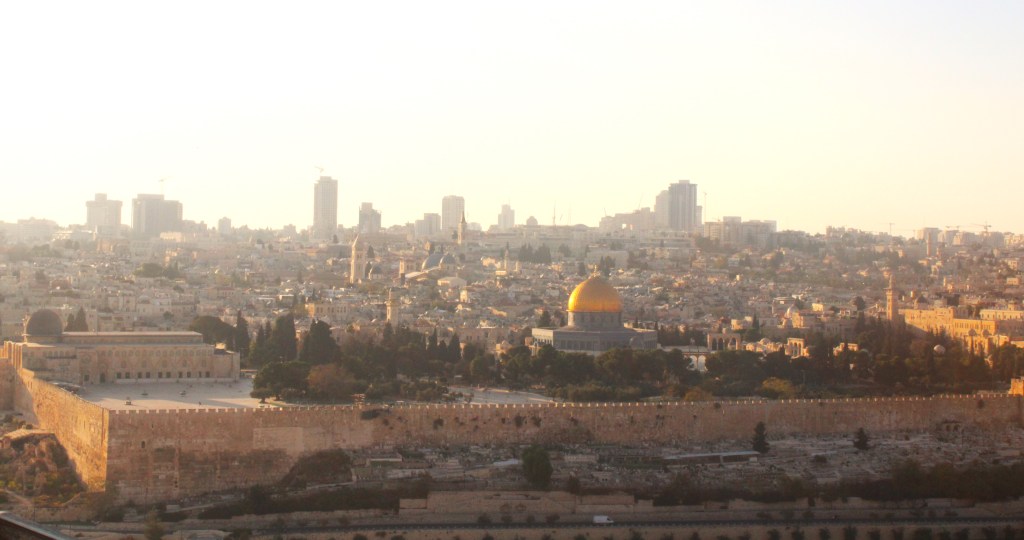
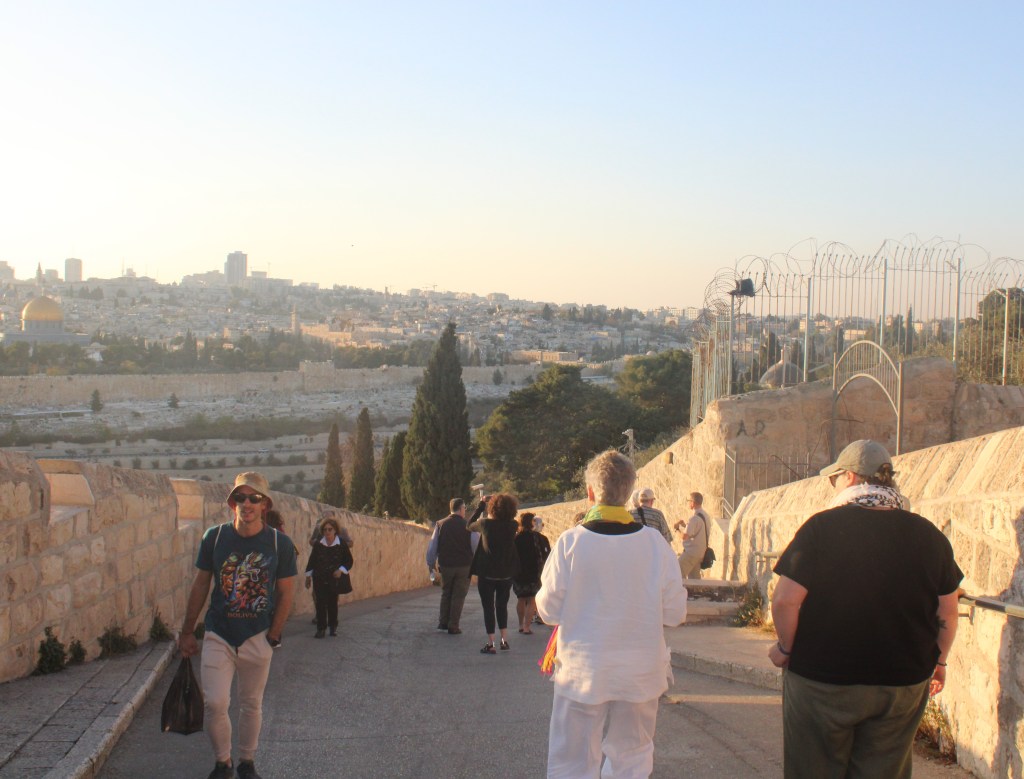
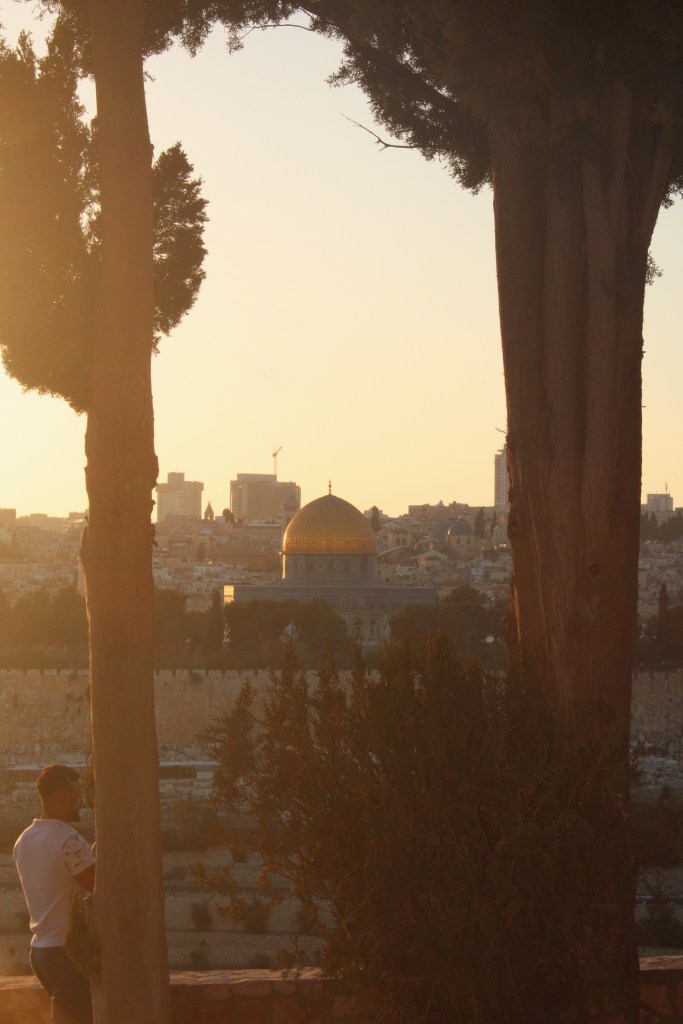
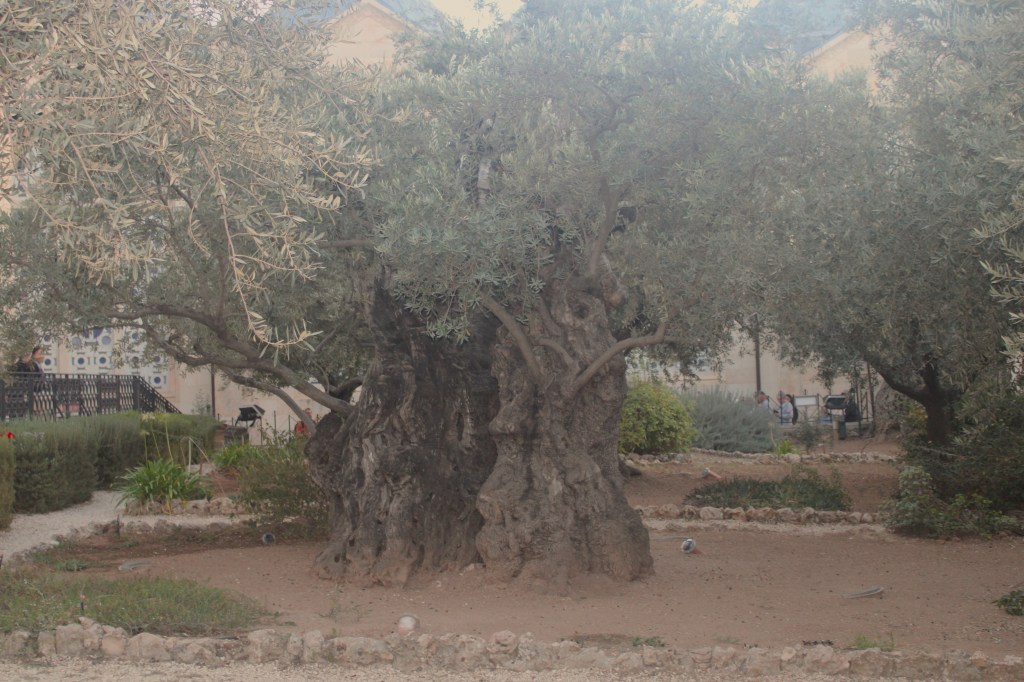
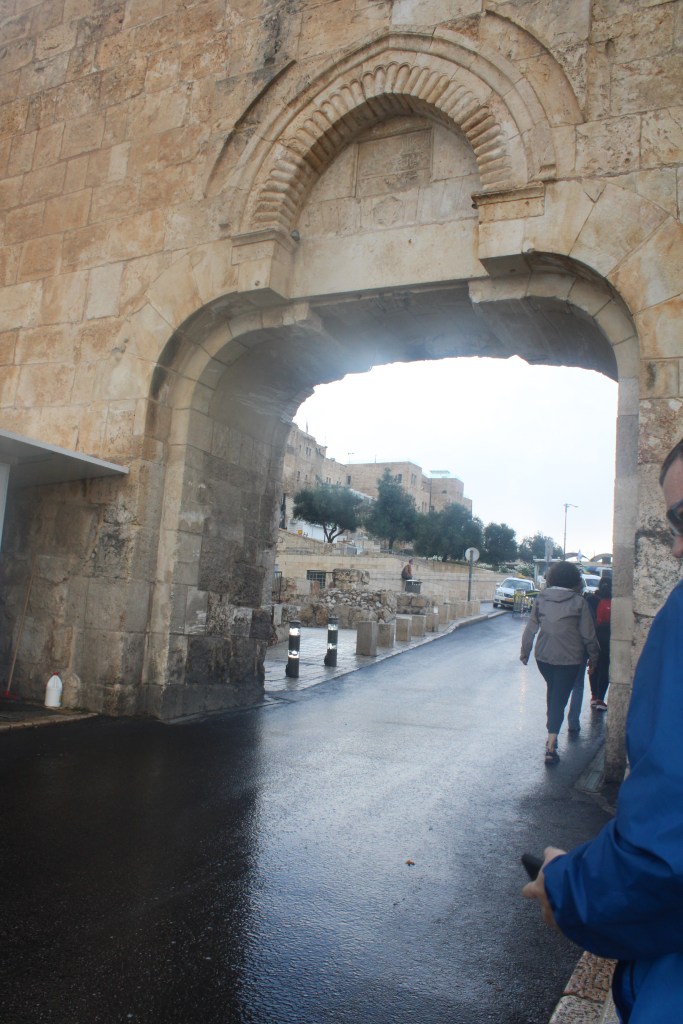
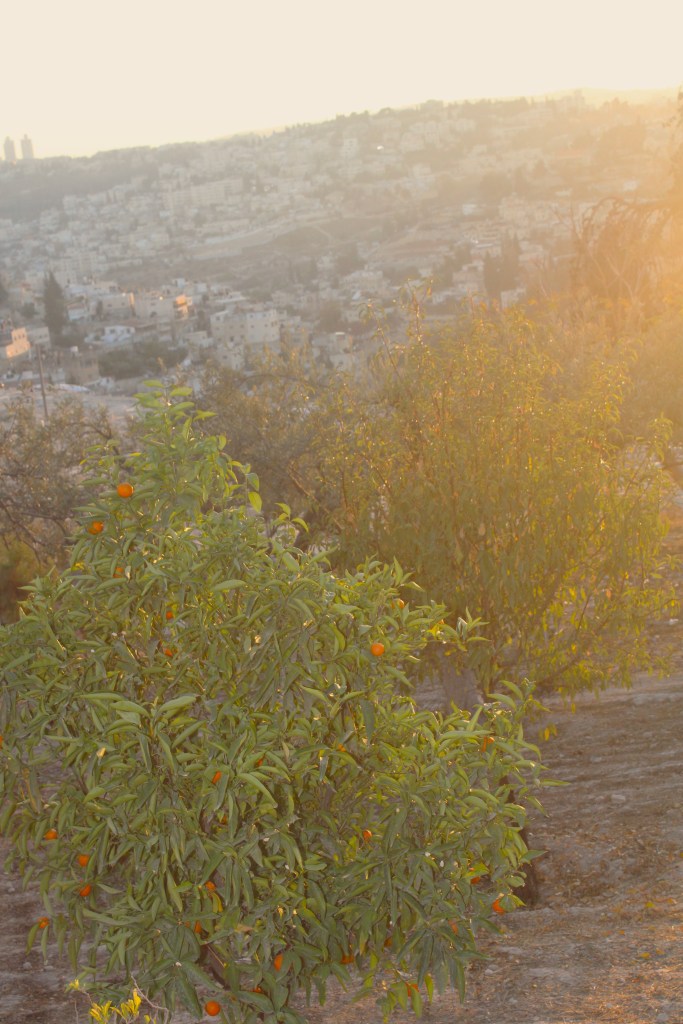
The photos with this post are from our pilgrimage to Israel-Palestine last November when we were able to look over Jerusalem and walk the path Jesus took into the city.
As the VDOT crew was setting up their cautionary signs of road work ahead yesterday, Baxter and I stopped to greet them and learned they were going to clean up the remains of a tree that had not so long ago reminded me of our quickly life can change, how quickly it can end. We […]
As the VDOT crew was setting up their cautionary signs of road work ahead yesterday, Baxter and I stopped to greet them and learned they were going to clean up the remains of a tree that had not so long ago reminded me of our quickly life can change, how quickly it can end.
We left them to work, but this morning we went back to where the tree had once stood. As time has passed, I began to wonder if perhaps the experience wasn’t as striking as it seemed.
Then, the neighbor who witnessed the scene and I were talking one day and to give me a time reference, he said, “You know, that day you almost got it.”
Still…
Today, I stood over holes in roadside from where limbs had pierced the ground and saw a crack in the pavement where it had crumbled. It seemed like I should do something. As I looked around, the brisk air stung my cheeks, the blue sky encouraged my spirit, the sound of the nearby spring’s rushing water washed away fears. The something I needed to do was live and love well. Bax and I picked up speed and added an extra mile to our planned walk.
Following is the message I shared with our church family on Ash Wednesday about my initial reaction. I’m grateful for the shattering. It’s my prayer that in the message you’ll find some nudge to help each other pick up the pieces and hold hands more fiercely, hug longer, and simply love. It’s our best response to being shattered.
On a Thursday a couple weeks ago, Baxter – my pooch – and I headed out for a morning walk. It was fairly warm and I was scheduled to work that evening so it seemed the perfect day to take a long walk. Once outside, I was struck fairly quickly by the wind. I didn’t remember any advisories or such so we kept going. Still, about 30 minutes in, I decided it was time to turn around. Small limbs were falling everywhere and it just didn’t feel great.
We got back to a stretch of road that was blocked by ridges on both side, but instead of sheltering us from the wind it seemed to be creating some kind of tunnel effect that was intensifying its force. I grew increasingly edgy and noticed that Baxter’s hackles were standing on end.
Then, I heard it. That crack akin to a rifle shot just behind us.
I turned to see a tree falling where we’d stood seconds earlier. The tree seemed to fall in slow motion. I watched as the trunk broke apart and the debris flew as it hit the pavement. I’m not sure how long I stood there before moving.
I finally started to walk away, but decided I’d better at least clean up the road enough so that vehicles could get by. Our neighbor who lived across the road joined us.
The tree had taken down part of his fence. I figured he wanted to assess the damage, but he came and stood next to me and declared, “That had to scare you.”
In the past, I might have attempted some bravado – some reassurance, some toughness. But, on that day, I looked him in the eye and said, “Yes. Yes, it did.”
He offered to drive us home, but I opted to walk, thinking the exercise might help ease the adrenaline coursing through me.
I took one more look at the tree’s remains and started to thank God for our safety. But before I could offer a prayer, I thought of the tens of thousands of earthquake victims in Turkey and Syria and, then, Jesus’ words that the Father “makes his sun rise on the evil and on the good and sends rain on the righteous and on the unrighteous.” I suspect that verse could also say that the earth shakes and trees fall on the righteous and the unrighteous.
I changed my prayer to one of gratitude for God’s presence.
Still, as I walked, in mind’s eye, the tree suddenly became symbolic – of situations in my life and around the world that seemed to be collapsing.
When I got home and finally sat down, the adrenaline was gone. The tears came and came some more.
The confrontation with my fragile finiteness unleashed tears that hadn’t been shed for so many things – big and small — coworkers with their positions eliminated, newspapers shut down, friends and family who are struggling, the earthquake victims, more personal deaths I hadn’t mourned properly, the miserable pain in my hip. I cried about all of it that morning. That day, I was shattered.
We all know in our minds that we are fragile and mortal, but, that day, I knew it in my heart.
In a few minutes, with a smear of ashes, I’ll remind you too that we all were made from dust and we’ll return to dust. But, right now, we’re here – likely all of us sitting to some degree or another in the midst of ashes — or fallen trees — of broken hearts, lost dreams, worries, aching joints, worrisome test results, dying friends, the knowledge of our sins and failures and temptations we can’t seem to resist. It’s a wonder we’re not crying most days.
But that, my brothers and sisters, is the incredible wonder of Ash Wednesday. This service, this day is devoted to telling the truth about our lives. They’re beautiful and we want to live. Yet, living can be so hard, so full of pain, loss, despair and sin.
The world outside these doors tell us we’re blessed when we don’t have a hair out of place, our car shines, and we’ve got it all together and are going after everything we want.
Today, in this service, we declare that’s not true. We are imperfect. We are fragile. We’re dependent on one another. Our bodies break. Sometimes our spirits do too.
Despite all that, we are blessed.
Today, we tell the truth. We remember what we’re made of.
That’s not easy. It takes courage to tell the truth, but when we embrace our reality we are so much more ready to love. We understand that our time to love and work for the Kingdom here is so limited and we know we can extend God’s love with messy hair, aching bodies, and dented cars.
The author of Psalm 51 shows us the way. He begins with a little reassurance – perhaps to himself – of God’s steadfast love. Then, he confesses his sin front and center – My sin is ever before me. I have done what is evil in Your sight.
With awareness of his sin, of his frailty, the psalmist then recognizes his need for God’s help. He begs for a new heart, while realizing that a broken spirit and contrite heart are what is needed for God to mold him into a new creation.
The Rev. Jan Richardson expressed this all so beautifully in her question. “Did you not know what the Holy One can do with dust?”
Do you know what our Lord can do with dust?
Lent is the season in which we remember Jesus’ journey into the wilderness and his path to the cross. It is the season where, I believe, we can most easily meet him face to face – our suffering and his suffering collide. Then, Easter comes and we are assured again that pain, death and dust do not have the final word. Our savior does.
Let us begin our journey toward Easter by telling the truth about our lives and remembering that we are made of dust and to dust we will return and, at the same time never, forgetting what our God can do with the dust.
As I prepared the ashes this evening, mixing them with oil, I didn’t blend them with a spoon, but with a piece of wood from the fallen tree. I went back and collected several pieces of the tree — a reminder to myself, to all of us that we are here today, that our God is with us and he can transform even that which feels completely shattered. Let us experience with the psalmist the joy of our salvation and offer a spirit willing to journey with Jesus to the cross.
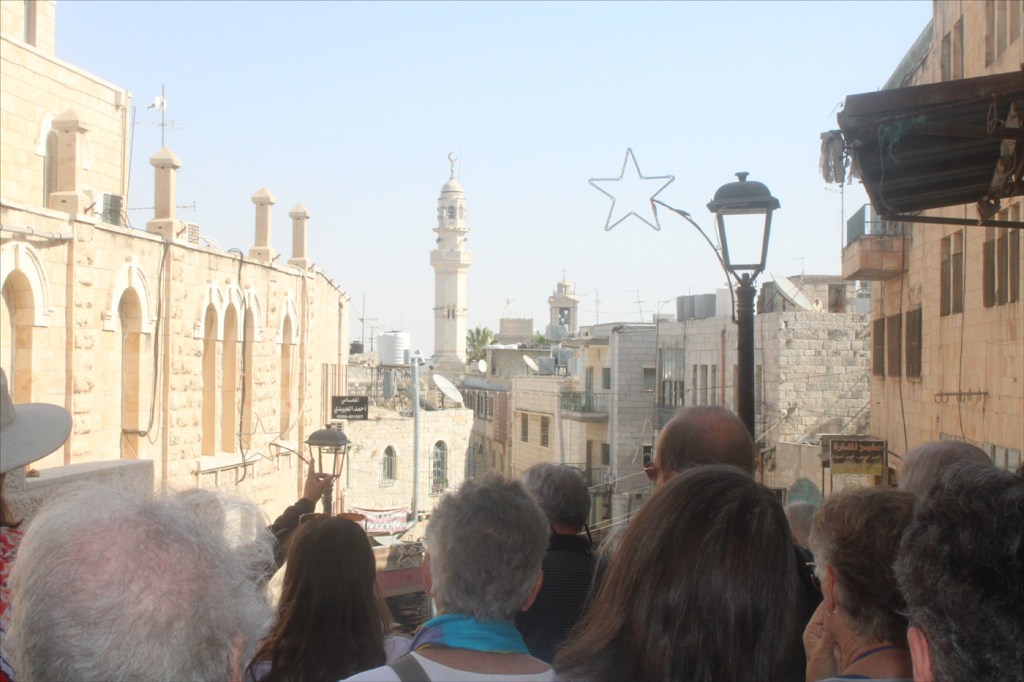
This view of Bethlehem features Christian churches and symbols as well as a Muslim mosque.
O little town of Bethlehem, how still we see thee lie
A half-century of visions of Bethlehem shaped by church plays and TV depictions of Jesus’ birth were abruptly replaced when one billboard caught my eye. The sign off a busy roadway displayed a bright yellow star.
In Bethlehem one might expect to see lots of heavenly star images of the kind that would lead magi to the Christ child. That was not this one. The advertising star was edged in red and included a smiling face.
We’d been told that Hardee’s operated an eatery in Bethlehem, but the reality didn’t sink in until I saw the billboard for its restaurant. KFC was promoted on another sign not far away, and multiple versions of coffee shops such as Square Bucks with a familiar-looking green awning were prevalent.
All that said, we were glad to be in the city celebrated as Jesus Christ’s birthplace. The trip to Bethlehem on the Saturday we arrived took longer than expected. Without warning Israel had shut down access to the main city gate leading to Bethlehem.
The reason given was innocuous, but everyone believed there was more to the story. Tension between Israel and Palestine was palpable.
About two weeks before we left home on our pilgrimage to the Holy Land, the U.S. State Department issued a travel advisory for Israel, the West Bank and Gaza. It read: “Terrorist groups, lone-wolf terrorists and other violent extremists continue plotting possible attacks in Israel and the West Bank and Gaza…. Violence can occur… without warning.”
For Gaza, the advisory was straight to the point: “Do Not Travel To: Gaza due to terrorism, civil unrest, and armed conflict.”
For Israel and the West Bank, the State Department urged “increased caution” and noted that U.S. government employees were not allowed to take personal trips into the West Bank and couldn’t make any overnight trips to Bethlehem.
The internationally celebrated city lies in the central West Bank of Palestine.
Already, clashes between Israelis and Palestinians had prompted our guides to skip two destinations on our itinerary.
One was Nablus, also in the West Bank, and home to a church that houses Jacob’s Well, where Jesus met the Samaritan woman, who likely was Jesus’ first evangelist.
In mid-October, according to the Israeli human rights organization B’Tselem, armed Palestinians killed an Israeli soldier. The next morning, the Israeli military shut down access to the city of Nablus and its surrounding villages. The B’Tselem report said, “Restricting the movement of more than 200,000 Palestinians has paralyzed life in the area, forcing hundreds of businesses to stop operating and harming the livelihoods of all their dependents.”
Describing the impact on the people, B’Tselem concluded, “This is what apartheid looks like.”
One of our guides, a Palestinian resident of Jerusalem, spoke of the ongoing tension. She estimated that about two Palestinians are killed by Israeli soldiers or police each week.
Sadly, her figure was too low. B’Tselem reports that more than 150 Palestinians have died in violent incidents this year, while about 20 Israelis have also been killed.
The hopes and fears of all the years are met in thee tonight.
The violence, heartache, and despair are all in evidence in Bethlehem.
The city remains home to multiple refugee camps, including Dheisheh Refugee Camp, which was established in 1949 and is home to about 13,000 refugees who were displaced during the 1948 and 1967 wars.
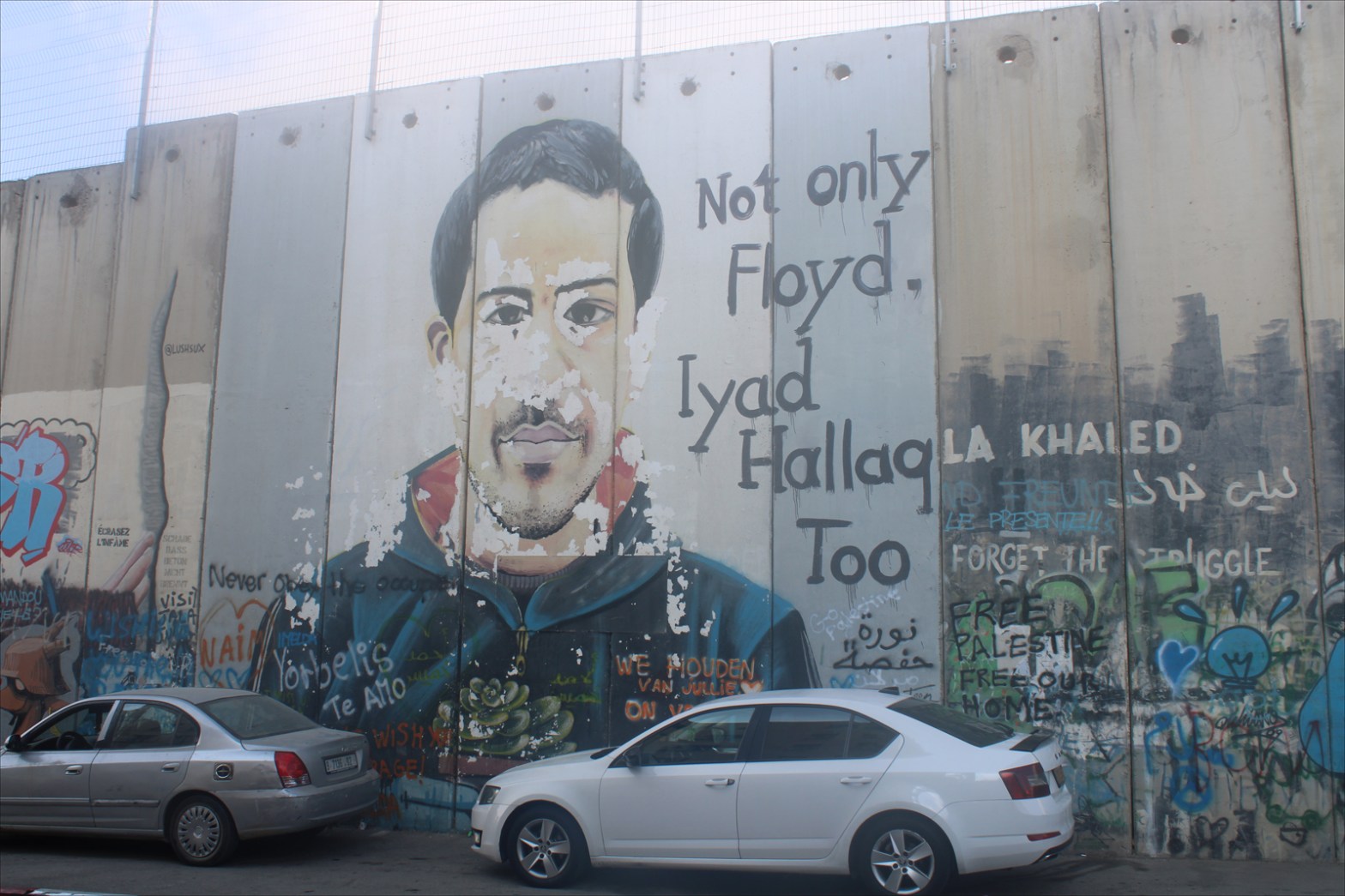
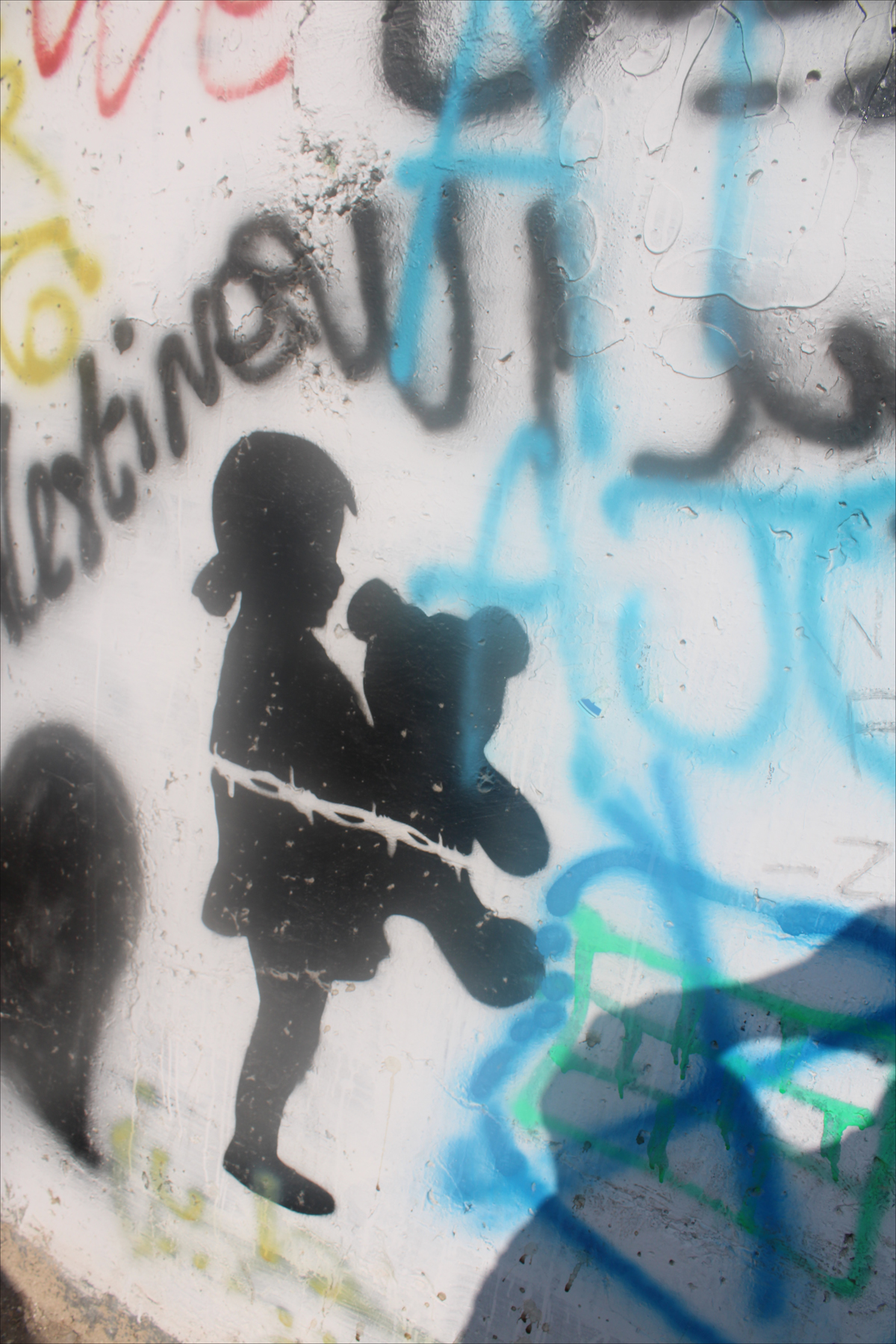
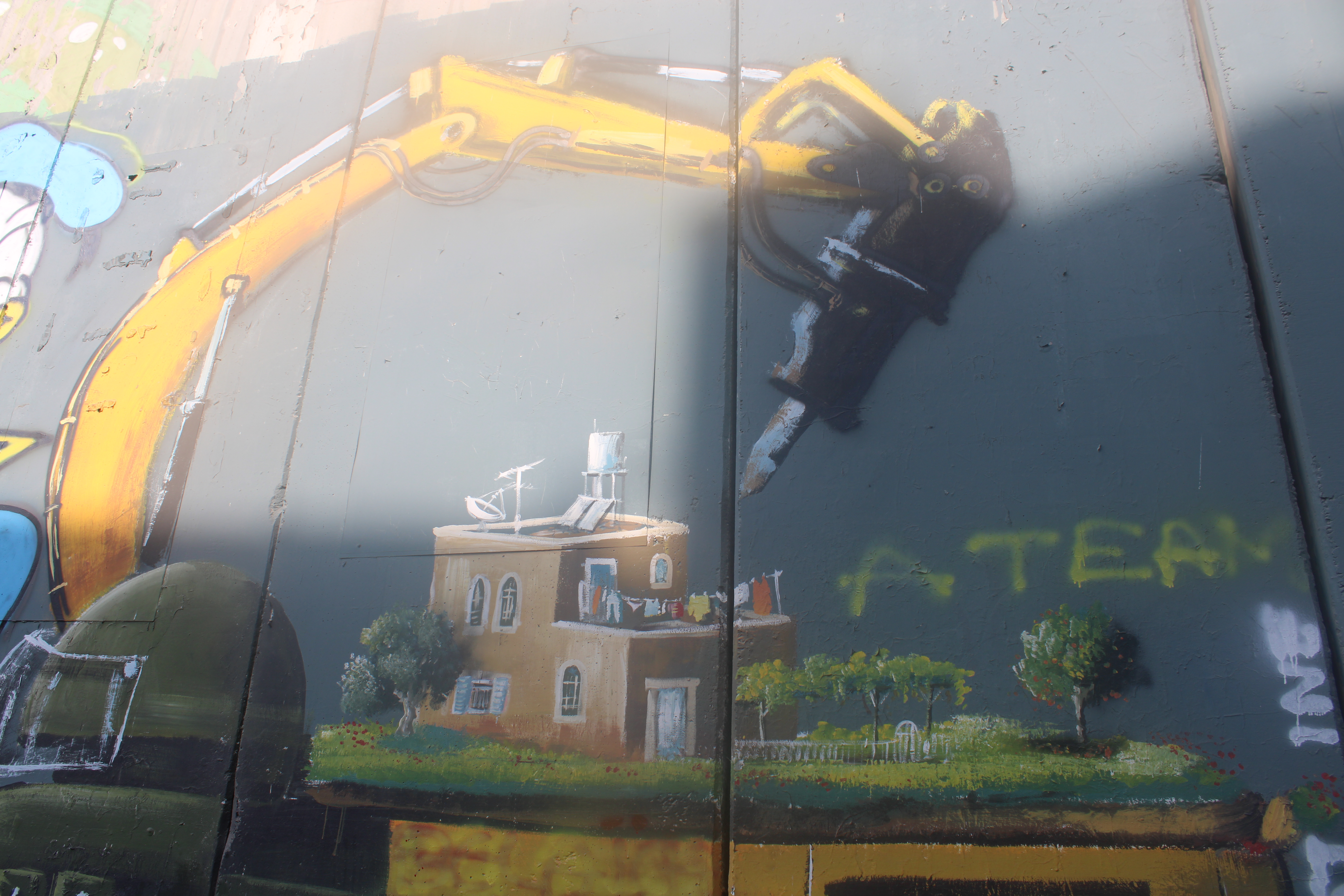
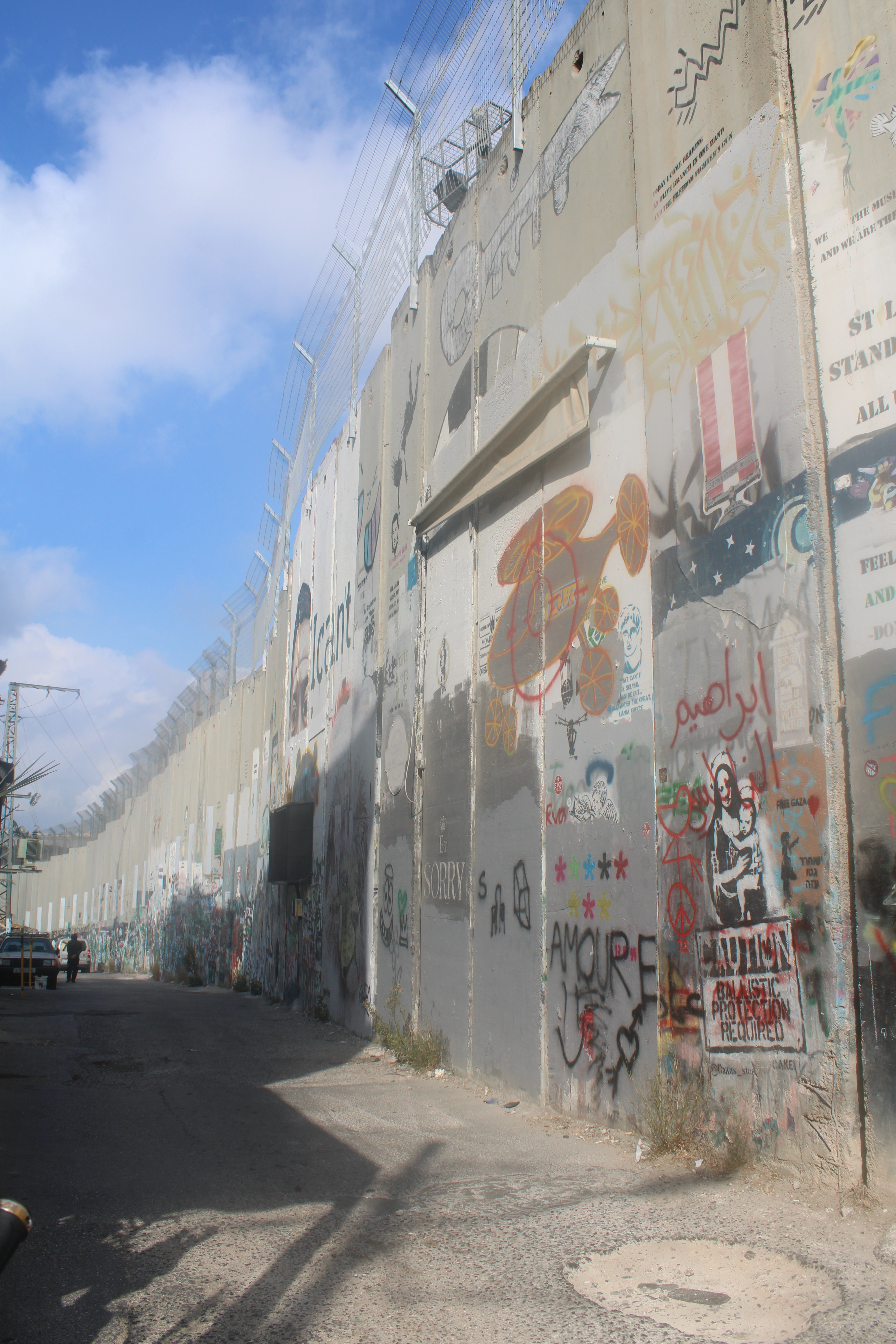
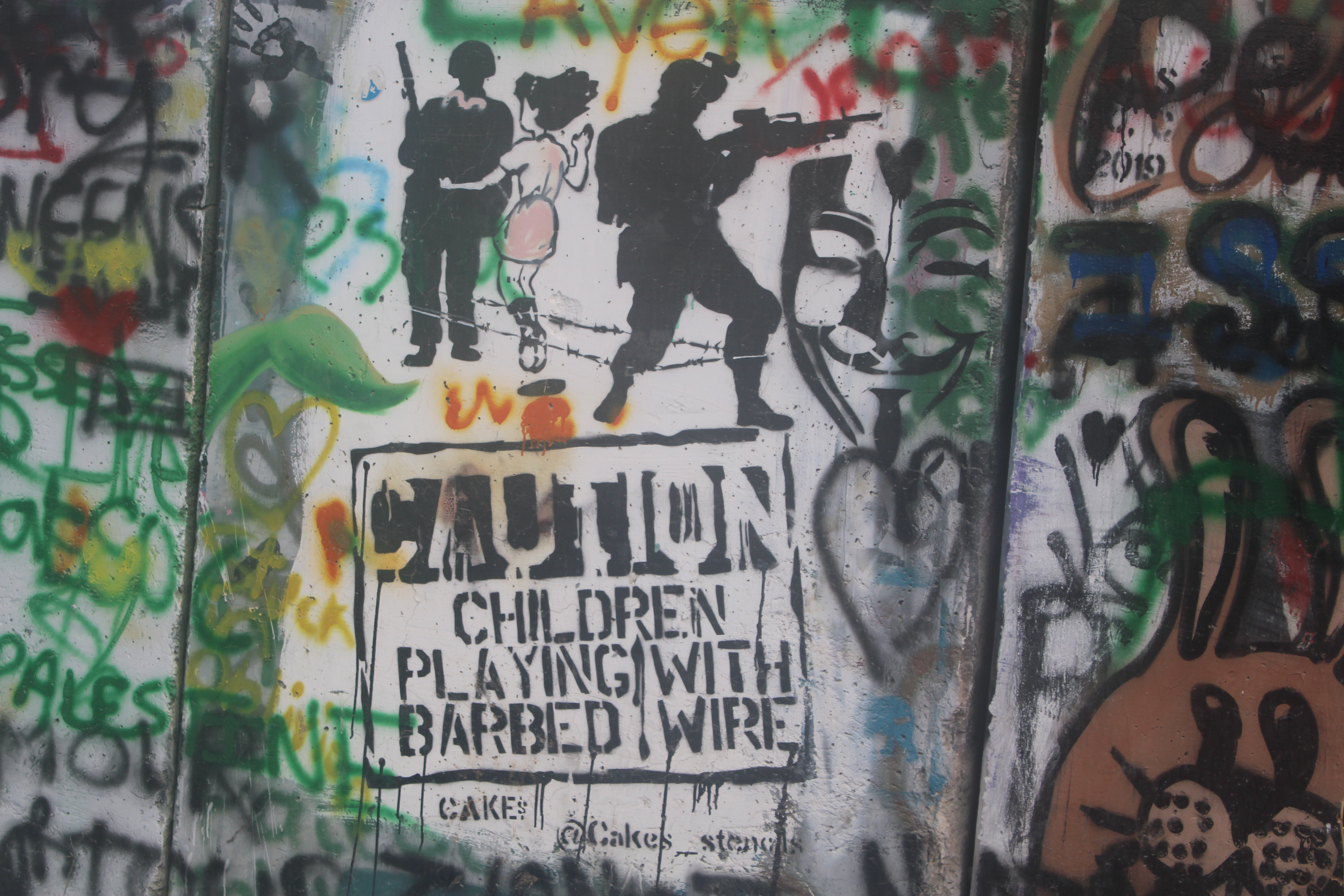
Then, there is The Wall, sometimes called the Separation Wall or the West Bank Barrier. Regardless of what it’s called, the 30’ high concrete wall cuts off Bethlehem from the rest of Israel. The barrier extends about 435 miles.
A columnist in The Wire wrote, “The wall is a constrictor that crushes Palestinian space, mind and body. The wall is a prison. To feel blessed to visit Bethlehem is a spiritual crime.”
And praises sing to God the king, and peace to men on earth.
Yet, I found a profound blessing in Bethlehem and felt a call renewed.
In Bethlehem, certainly there are those who respond to the oppression with violence. Multiple Palestinians we spoke with in Bethlehem and elsewhere repeated the same statement: “We are being strangled.”
And, many are fighting back, and many are doing so through art and presence.
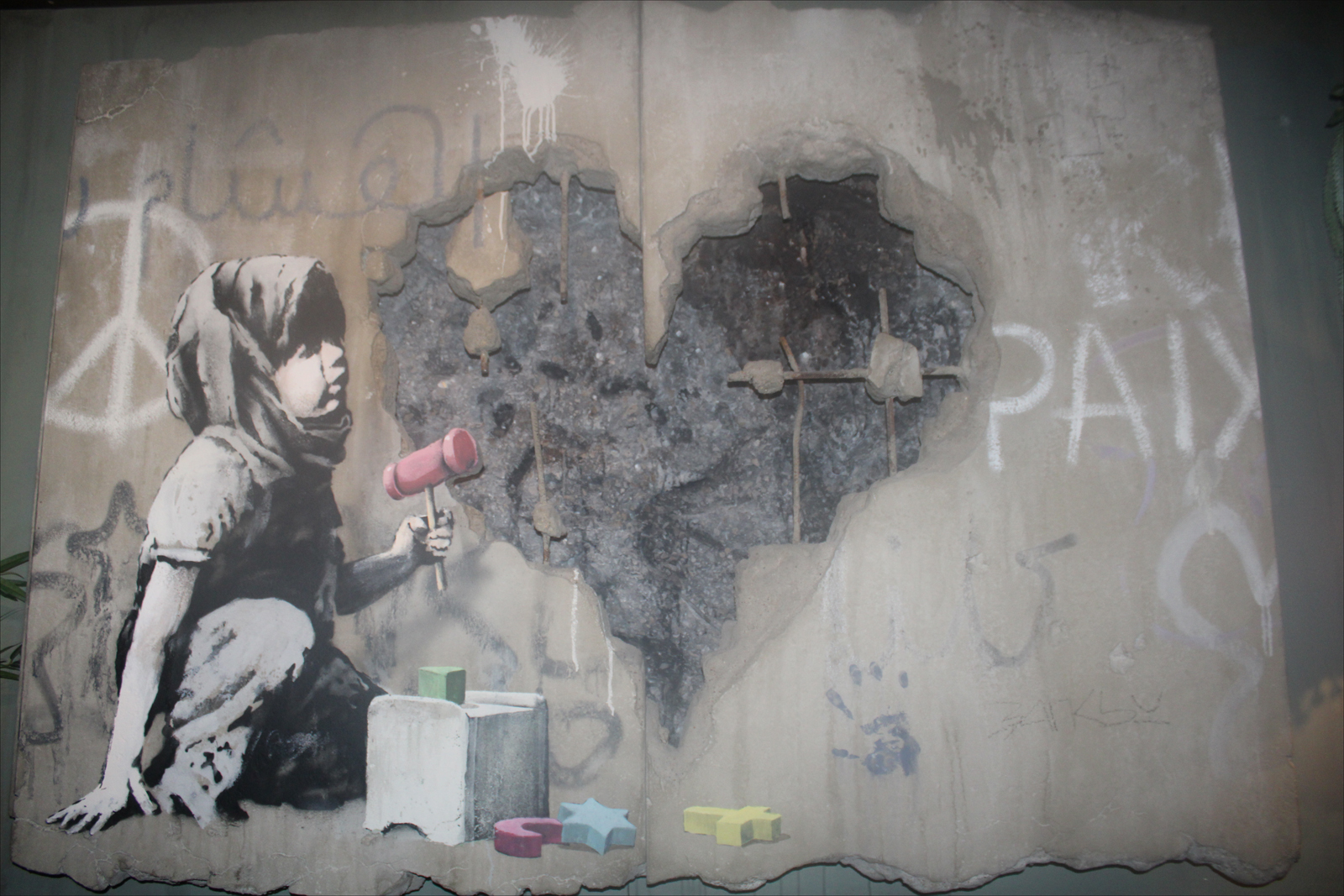
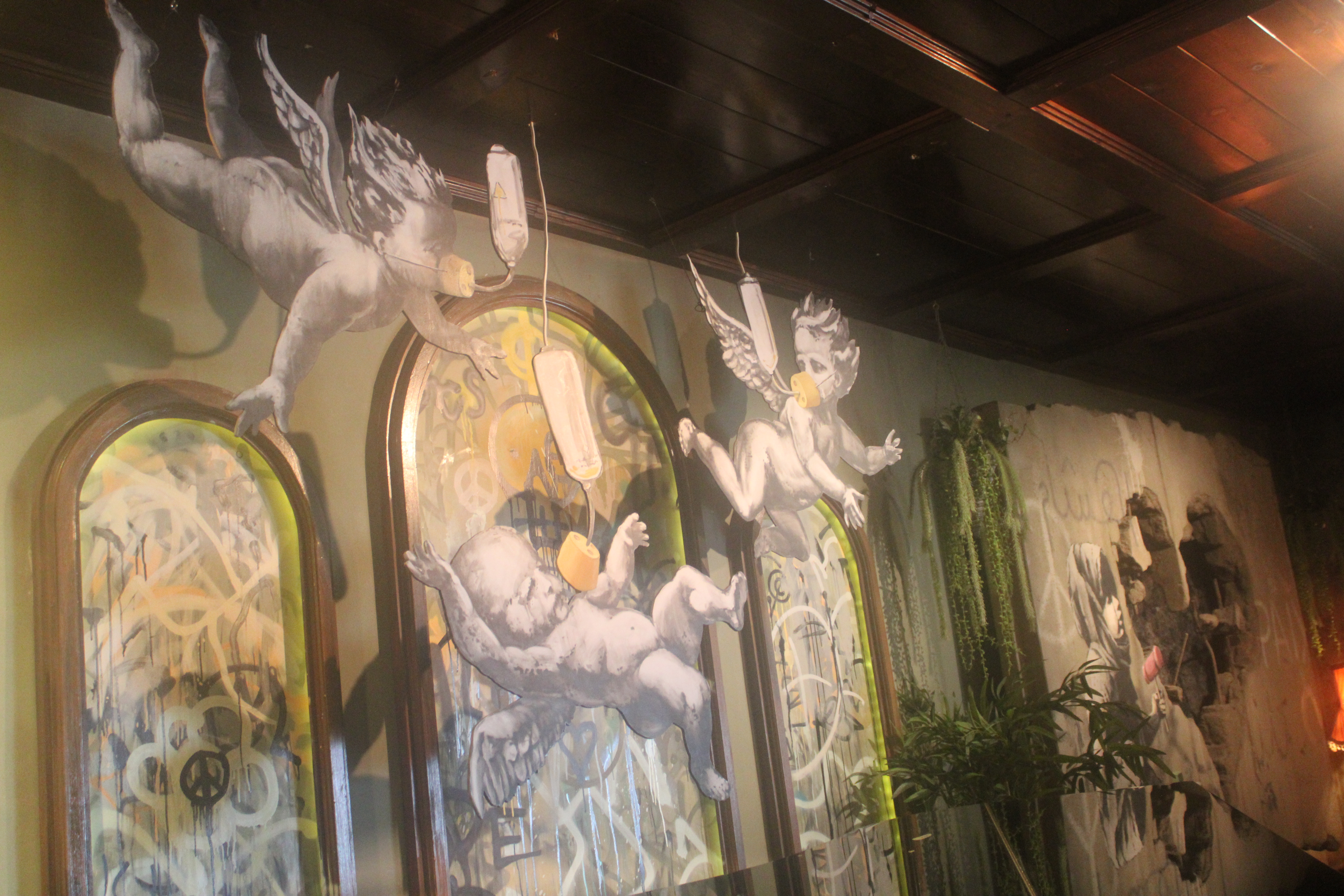
The anonymous artist Banksy opened a hotel with a view of The Wall.
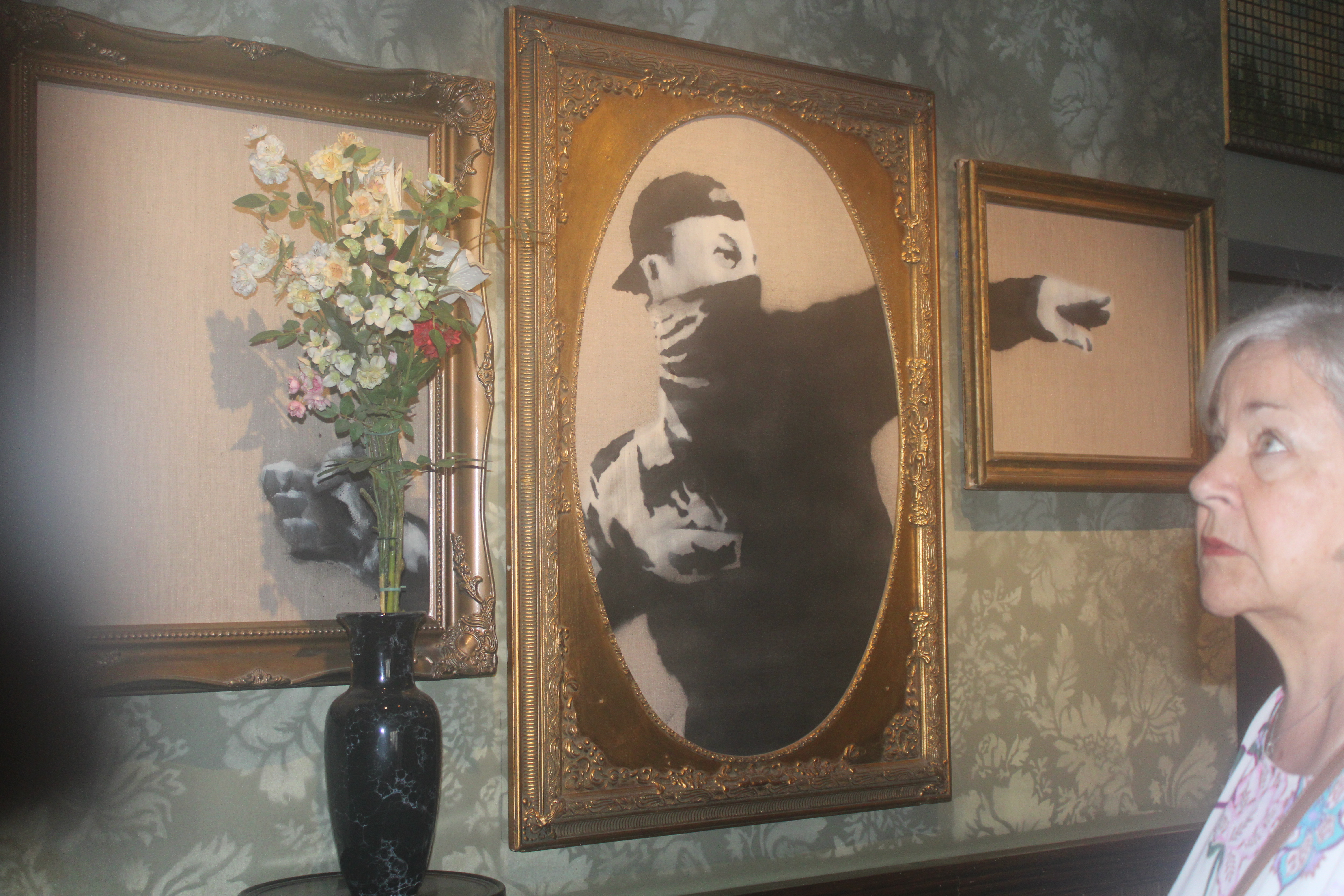
The Walled Off Hotel has been described as “a hotel, museum, protest and gallery all in one, packed with the artworks and angry brilliance of its owner, British street artist Banksy.”
The museum and the art provoke multiple emotions – tears to clenched fists, horror to self-reflection.
Outside, the graffiti on The Wall, some created by the internationally celebrated Banksy, prompt the same sadness and anger with little glimpses of hope.
One poignant piece of art depicts a shrouded terrorist with a mirror in the eye area so when you look at it, you see your own eyes staring back.
I couldn’t help but wonder, “What is my role in all this?”
The answer came in two places.
Where meek souls will receive him, still the dear Christ enters in.
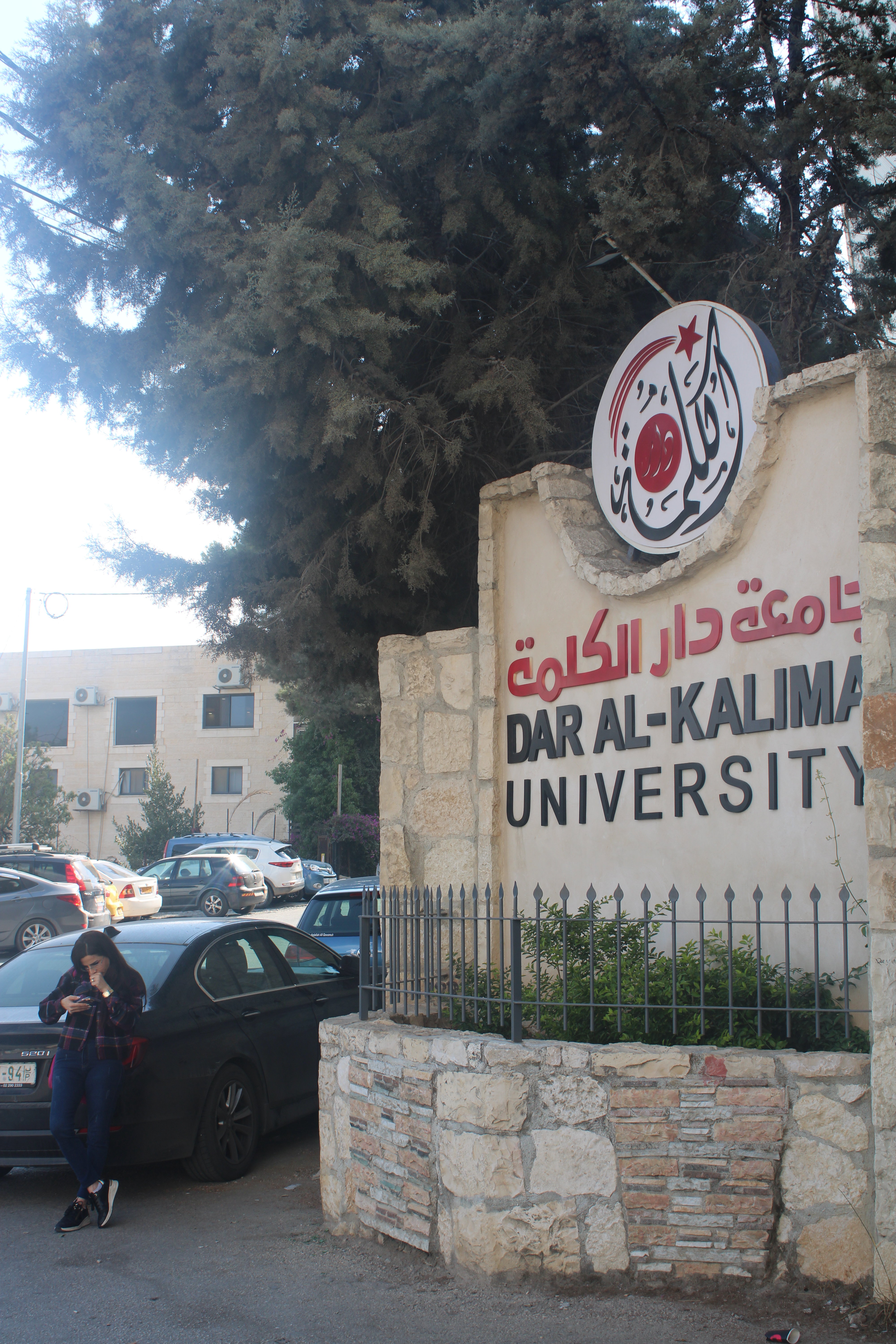
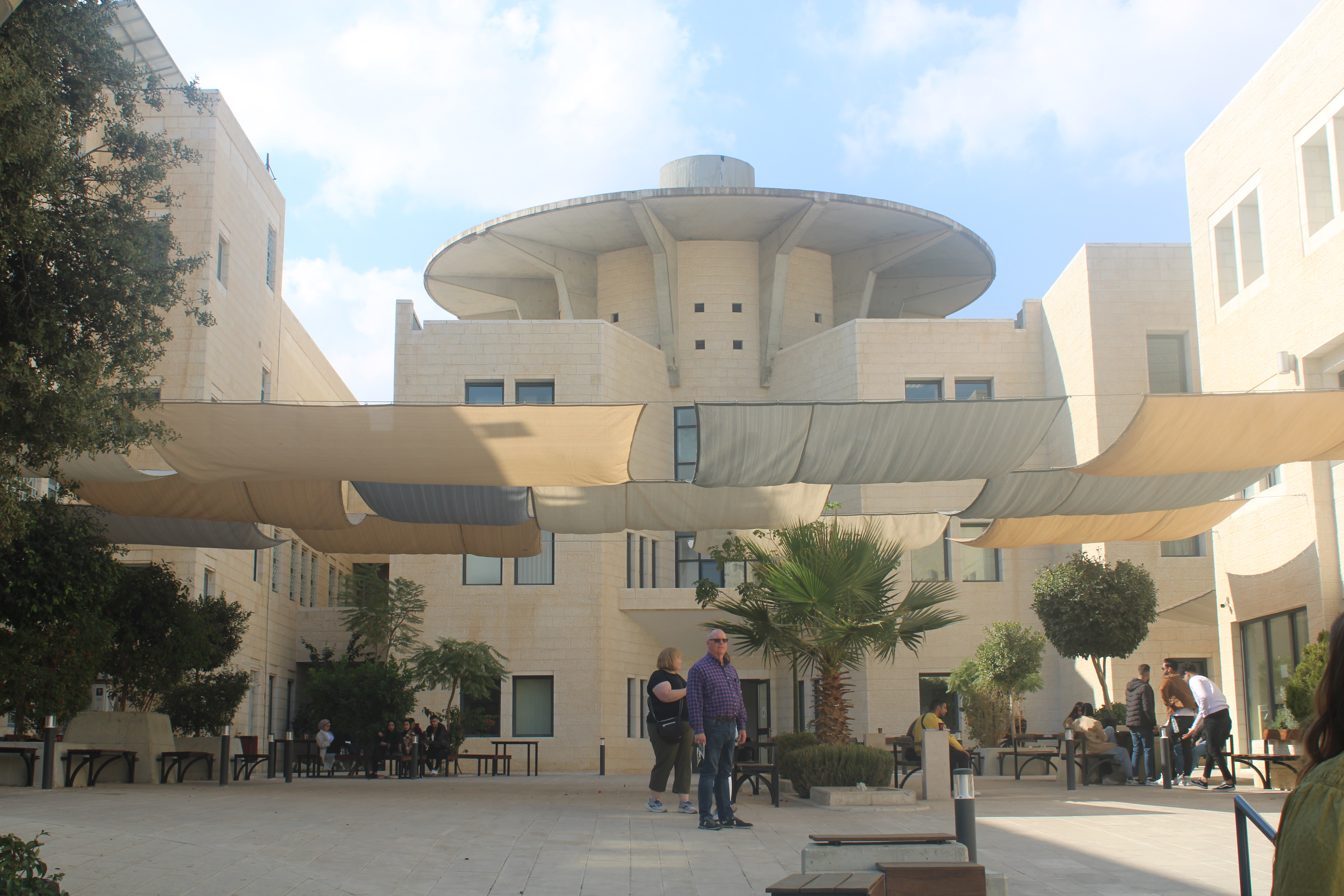
We had an opportunity to meet with a native of Bethlehem, who serves as a vice president of Dar Al-Kalima University, Rana Khoury.
She too declared, “We are strangled.”
In equally stark language, the woman, who has spent and spends time in the United States, said, “It is a very helpless place…. We are prisoners.”
Just driving down the highway in her hometown is a scary experience for Khoury and her fellow Palestinians.
At another point, Khoury, who is a Religion, Conflict, and Peace Initiative Fellow in Harvard Divinity School’s Religion and Public Life program, held her hands to her throat and declared, “We’re choking.”
The circumstances of life in the West Bank tell Palestinians “You are nothing,” Khoury said.
Yet, Khoury, who isn’t allowed to use the international airport in Tel Aviv or travel to Jerusalem because of her status as a Palestinian, tells all the students that she encounters, “You are not your circumstances.”
She and the university work to empower the students, and Khoury is developing a civic engagement curriculum for students at all Palestinian colleges.
She fights for hope.
And, at times sees its light.
Recently, she noted some of the university’s students took third place at the renowned Cannes Film Festival. The university is empowering its students to tell their story through the arts – whether it be through film, theatre, jewelry design, architecture or food.
Khoury is seeing the results. “Hope is manifesting itself.”
“Palestinians,” she said, “have developed the art of living with hope.”
For those of us who were returning to Canada and the United States and don’t see concrete, razor wire, and soldiers carrying automatic rifles on a daily basis, we asked Khoury, “What are we to do?” Khoury was again direct. She said, “Once you see, it becomes a question of justice… Just keep speaking about it. You’ve seen it.”
Even more, she directed each of us to engage in matters of justice at home wherever we live. “Be open and engaged with questions of justice.”
That’s no easy directive even here, but it is essential for all who follow the savior born in Bethlehem, a community in distress then and now.
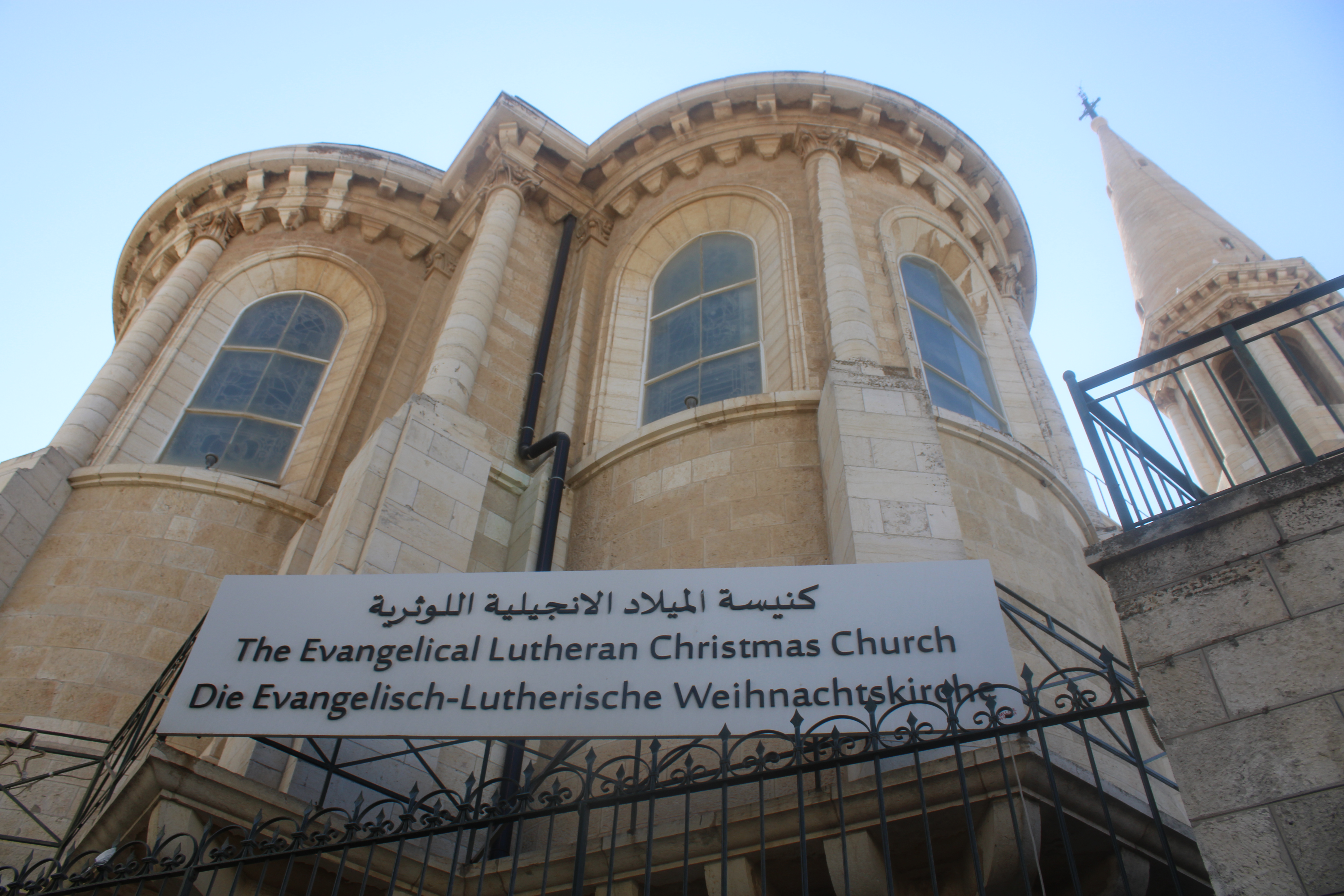
Khoury’s call to action is accentuated by sounds and images that I treasure from a worship service at The Evangelical Lutheran Christmas Church in Bethlehem.
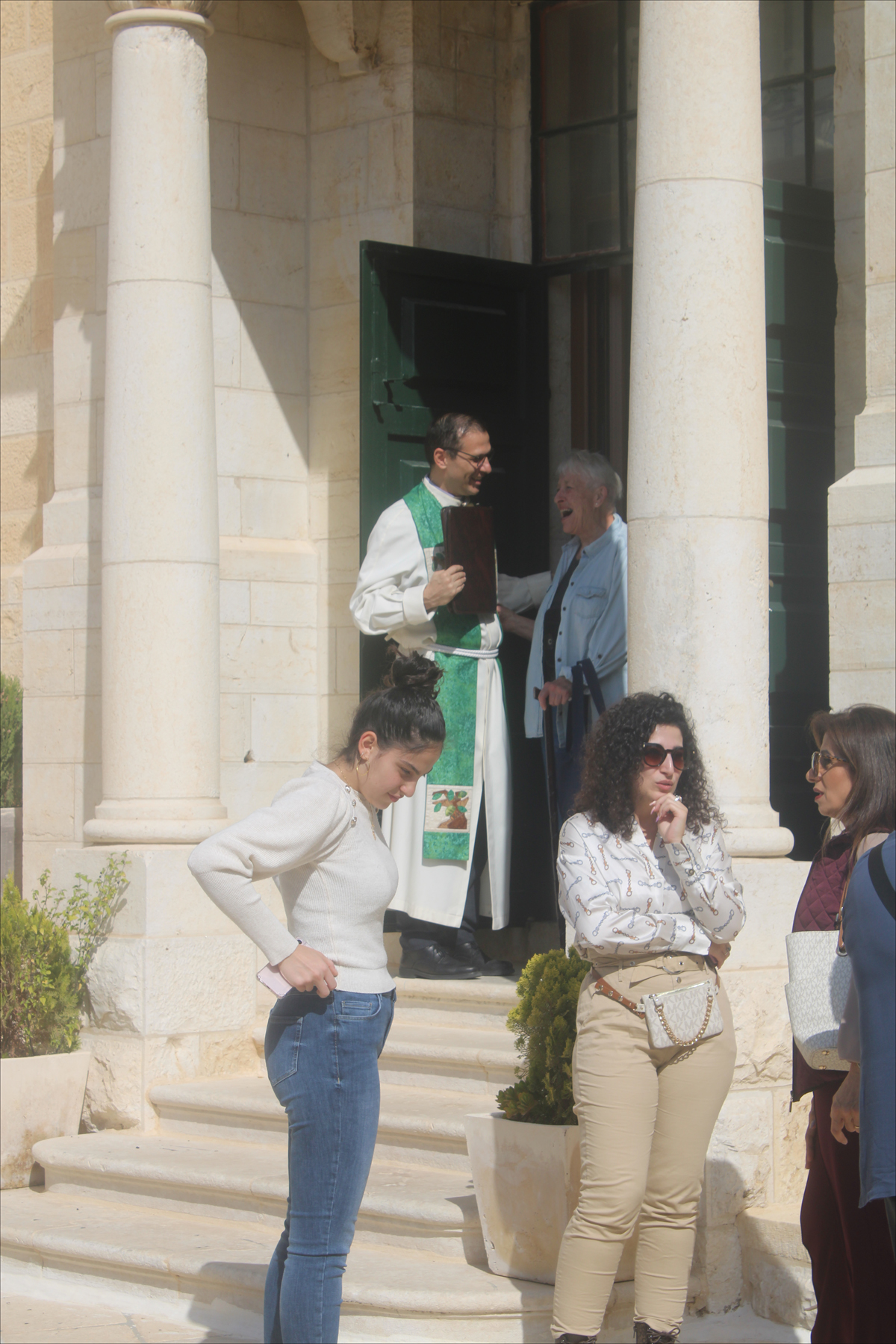
Though the congregation traditionally worships in Arabic, we were able to join in and recite the Lord’s Prayer and sing hymns in English. In worship, the two quite distinct but equally beautiful languages merged into one of Love as they lifted to God.
Later in the service, we discovered that each member of the congregation is given a hunk of bread during the Lord’s Supper, not a tiny bite or cracker than can easily be consumed in one quick act. Returning to my pew after receiving the elements, I watched children walk back down the aisle after receiving communion. A little boy was cramming the bread dipped in wine into his mouth and spilling crumbs across the floor.
The beauty and grace overwhelmed me as the scene assured me of God’s abundant love for all His children.
The pastor of Christmas Church, Munther Isaac, has written a book titled “The Other Side of the Wall: A Palestinian Christian Narrative of Lament and Hope.”
Isaac tells his story as a son of Bethlehem who knows the injustice and suffering firsthand but also believes in Jesus.
He writes, “Hope is not an exercise of waiting while doing nothing. What we hope for in our communities, nationals, and world should shape our… actions within them.”
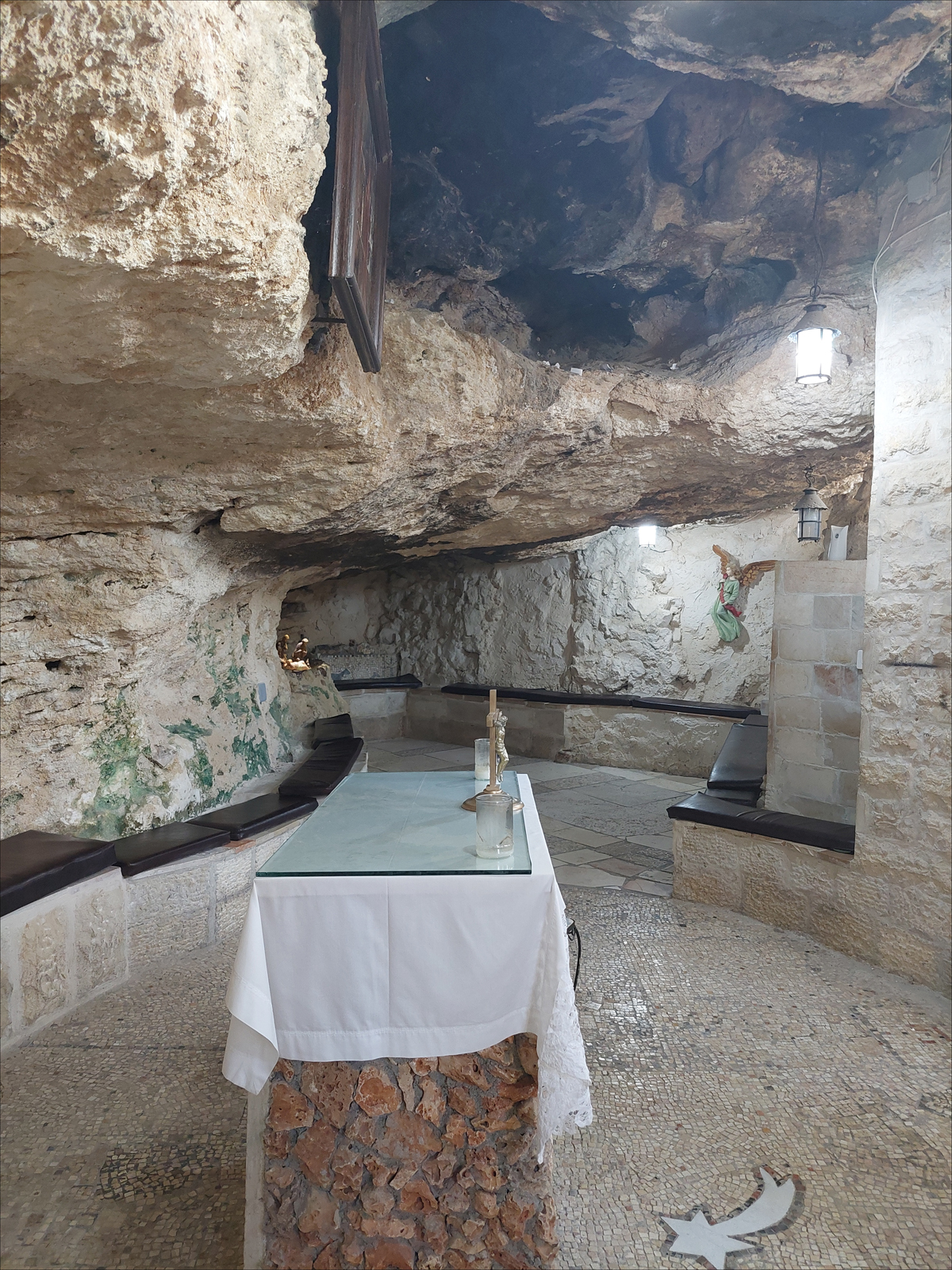
During a more traditional moment in our pilgrimage, we visited a cave believed to have been one the shepherds who received the angelic message of Jesus Christ’s birth would have slept in.
Sitting inside, we joined our voices together and sang “Gloria in Excelsis Deo,”or “Glory be to God on high,” as part of “Angels We Have Heard on High.”
A verse of the old carol cries out, “Come to Bethlehem and see him whose birth the angels sing; come, adore on bended knee Christ the Lord, the newborn King.”
In the faces of artists, a university leader, a pastor, and a little boy scattering crumbs, I saw the face of Jesus Christ.
My prayer this Christmas is that you’ll also see his face and hear the call to act for hope.
From Walmart during the holidays to the Via Dolorosa
This is the first post in a series inspired by a recent pilgrimage to Israel-Palestine.
The holiday shopping season is on! By the time you read this column, we’ll have survived Black Friday, Shop Small Saturday, and Cyber Monday.
Not a fan of crowds and chaos, I didn’t take part in the buying frenzy until Sunday when several needs took my husband, Doug, and me into one of the area’s Big Box stores. Thirty minutes later, after using a bag of birdseed as armor, I collapsed into our pickup, vowing no more weekend shopping until January.
An earlier conversation with a friend about the commercialization of Christmas came back. Not a man of faith, he still bemoaned the season’s apparent loss of meaning. The season is all about dollars and stuff, he declared.
My head nodded in agreement, while also realizing that there’s more to the story.
Earlier this month, I’d also felt the need for armor while walking the Via Dolorosa in Jerusalem. The route lived up to its name – sorrowful road or way of suffering. The Via Dolorosa runs through the Old City in Jerusalem and is believed to be the path that Jesus walked from Pilate’s judgment to the crucifixion.
Designated with Roman numerals, the Via Dolorosa includes 14 Stations of the Cross. The fifth is the site where Roman soldiers forced Simon of Cyrene to help Jesus carry his cross.
Today, 14 Stations of the Cross along the route represent significant events described in the New Testament. Many of the stations are churches such as the Chapel of Condemnation where Jesus was sentenced to death and the Chapel of the Flagellation, where he was beaten by Roman soldiers.
The Via Dolorosa ends at the Church of the Holy Sepulchre, which includes an area celebrated as Jesus’ tomb.
Pilgrims walking the Via Dolorosa are urged to dress modestly with shoulders and knees covered, especially inside the Church of the Holy Sepulchre. That seems most fitting. The experience should be met with reverence and respect.
Preparing for the pilgrimage, I’d spent time immersed in scripture, research, and prayer. I thought I was ready, but little signs along the way suggested otherwise. Our guide cautioned us about protecting valuables. That made sense; it would be crowded.
Then, she also advised us to be wary of some shopkeepers.
Shopping? On the Via Dolorosa?
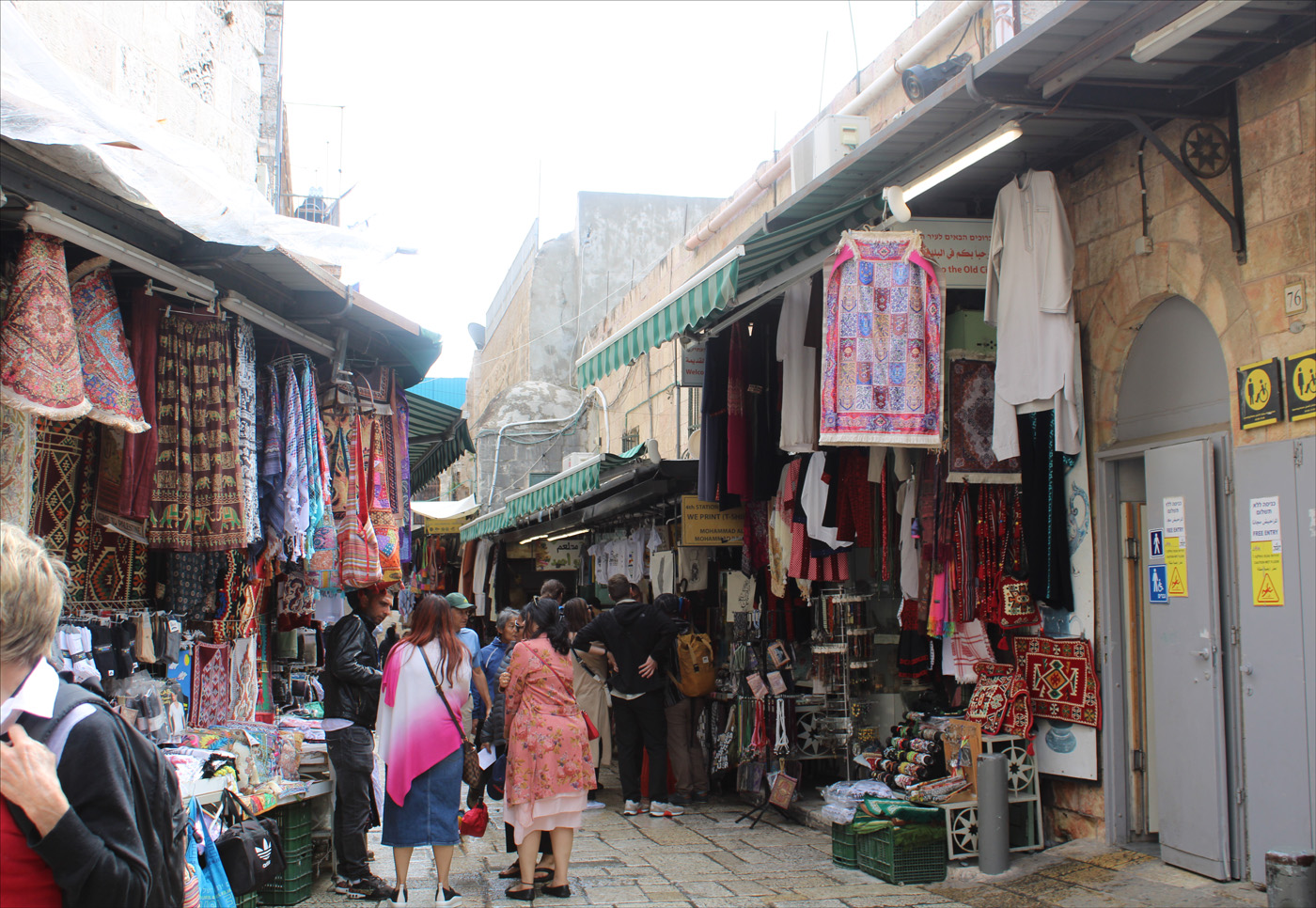
Oh, yes! Pilgrims apparently have money to spend and, to say the Via Dolorosa has been commercialized, would be an understatement of significant proportions.
When one vendor jumped in front of me, waving scarves, and suggesting I could have five for $20 U.S. dollars, then, when I shook my head, five for $10, I knew this reverential experience was going to take a different shape from any I’d imagined.
Distractions are many along the Via Dolorosa. You can buy scarves – lots of them, many beautiful. There’s also jewelry, leather goods, woven rugs and bags, olive wood products, cheap T-shirts, and trinkets of all kinds. Vendors will eagerly sell you fresh pomegranate juice or tasty Jerusalem bread. (Both get a double-thumbs-up.) And, if your stomach rumbles and you want a full meal, there’s no shortage of options.
The shoving and pushing doesn’t always end inside the churches. Just like when lines form outside a retailer that’s got the remaining dozen or so of this year’s must-have sensation, people will grab you and try to move you to get a quicker two-second glimpse of the tomb site. Our guide was constantly urging us to form a tight impenetrable block in the line. Still, someone grabbed one of the men in our group. We held firm, and no one was hurt.
Using defensive football blocking techniques on the Via Dolorosa was not among my preparations.
Moments of discouragement and disappointment threatened to overwhelm me. More than once, tears welled up.
But, along the way, I also watched a man give his arm to a woman walking unsteadily on the uneven cobblestone road – one of many acts of kindness that could be easily overlooked but persisted through the crowds and chaos.
Walking the Via Dolorosa is a metaphor for living.
Distractions are plentiful in this life. Plenty of folks are waving scarves in our faces. They’re just more often doing it through TV commercials – often for $19.95.
Pushing and shoving can take lots of forms too. Maybe it’s subtle pressure to take on a project you really don’t want to do or vote a certain way or name your child after a long-dead ancestor.
Sorrow and suffering are plentiful and dominate the headlines. That acknowledged, kindness and love are abundant too. Watch carefully and you’ll see so many people offering their arms, hands, and good words, striving to make negotiating the Way easier. They’re trying to follow in the footsteps of the one that the Via Dolorosa remembers and heed the new commandment he gave a short time before making the way to the cross: “That you love one another.”
As St. Paul suggests: May our armor be that of Light.











 Minding the Light